

Drone videography is becoming increasingly popular. Technology companies have created models for every taste, covering everything from simple to professional shots. Undoubtedly, one of the most impressive features is FPV, which gives the user the ability to view the scene from a first-person perspective.
See also: Amazon: Product deliveries by drones will soon begin

One of the most famous models to feature this feature is the DJI FPV. And now DJI's Avata is the second FPV model and the first cinewhoop.
It packs a feature set and a robust build into a smartly designed, streamlined solution. A typical drone doesn't have automated controls to stop or hover in place, like DJI's FPV drones do. DJI's models also don't require you to know how to wire your own camera or motors, or how to set up radio frequencies and remote controller configurations.
DJI listened to its users' feedback on its first FPV drone, fixing the flaws with Avata.
At 410g, it's almost half the weight of its predecessor, and it's also smaller. If it doesn't crash, the Avata probably won't need to be sent in for repair thanks to a compact frame and built-in protective propellers. It also features an improved camera with a 48MP, 1/1.7-type CMOS sensor that can shoot video at up to 4K/60p and 2.7K/120p.
Avata also features a new Turtle Mode that flips the drone right-side up if it lands upside down on the ground. Additionally, a smaller, lighter, and more user-friendly DJI Goggles 2 headset is available as part of the Avata package. Avata is clearly aimed at beginners, as it is ready to fly, straight out of the box.
Those who have spent time learning how to build and fly their own FPV system probably wouldn’t be interested in the Avata. Looking at the numerous offerings from FPV hobbyist sites, a typical FPV body is about 3–5″ (7.6–12.7 cm) long and wide.
The Avata, while smaller than Mini 3 , is still larger than the majority of cinewhoop FPV drones on the market.
If you’re hoping to do complex flights in close proximity to people or objects, the Avata probably isn’t going to work. It’s an FPV drone for people who want to soar high above mountains or coastlines and not worry about losing the drone if it disconnects from the remote. GPS and GLONASS, which aren’t found in most FPV setups, make these safer flights possible. The propeller guards on the Avata are part of the main frame.
Pilots familiar with DJI functionality and features will find this FPV drone familiar and comfortable to operate. Also, those looking to combine some FPV footage with other cinematic clips they've shot with similar DJI drones will find it easier to integrate, as the cameras have similar color profiles.
A DJI Avata Pro-View Combo includes the drone, Goggles 2, and hand-held motion controller. DJI also offers a Fly Smart Combo ($1,168) that includes the original Goggles V2 developed for the FPV model. The Fly More kit also includes two additional batteries and a charging hub for an additional $220.
See also: Axon halts plans for controversial Taser drone
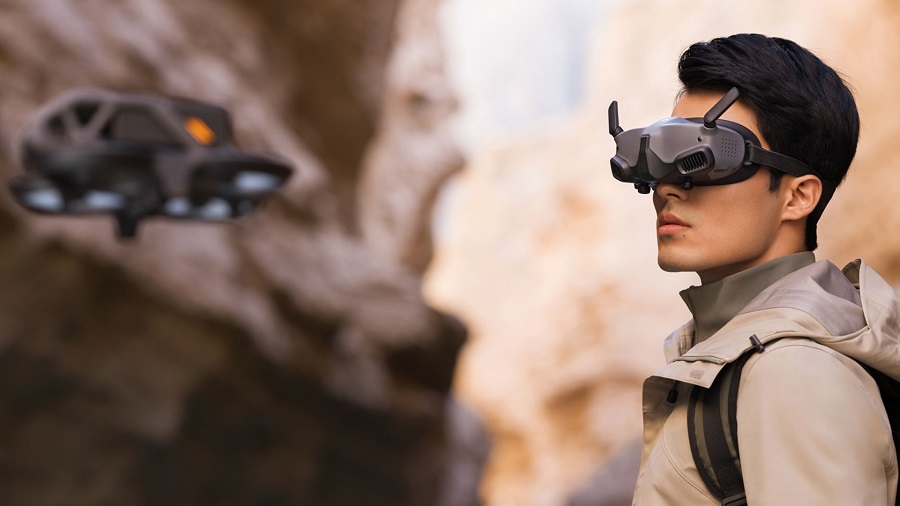
The Goggles 2 are sleeker and smaller than the original V2. There are vents on one side, presumably to keep them from overheating, and the frame doesn't cover most of your nose. This makes them more comfortable to wear for longer periods of time. They have two antennas protruding from the top instead of four, making them more convenient to carry.
Instead of pressing a button or turning a dial on the top right of the goggles to adjust settings, the new Goggles 2 features a touchscreen that responds to the movement of your index and/or middle finger. By swiping up, down, or forward, you can activate camera settings, a shortcut menu, and the main menu.
Like their V2 predecessors, the Goggles 2 rely on an external 16.2 Wh battery that is connected via a USB-C. At the end of the cable is a clip that attaches to the top of the battery for added security. The Goggles 2 and the Avata drone connect using DJI’s O3+ (OcuSync) transmission technology, giving the drone a range of 10 km (6.2 miles) with dual frequencies.
The Avata can be flown with DJI’s hand-held motion controller. It fits easily in one hand and features buttons that let you launch the drone, brake, and hover, as well as a trigger on the front that lets you accelerate up to 54 km/h. You can steer the drone left, right, up, and down by moving your hand and wrist.
It’s worth noting that you can only fly the Avata in Normal and Sport modes with the Motion Controller. To use it in full manual mode, which allows you to perform flips and rolls, you’ll need DJI’s FPV 2 remote controller. This remote controller is ergonomic and gives you instant access to features you’ll need, such as Return to Home, flight modes, camera profiles, and gimbal wheels.
DJI's standard Fly app is more limited than usual for the Avata, with only three menus to access. Camera settings displayed at the bottom of the screen, a shortcut menu at the top, and a main menu, are all easily accessible and navigable with a two-finger tap.
Because Avata has built-in propeller guards, it only requires two obstacle detection sensors on the bottom that determine whether conditions on the ground are suitable for landing.
See also: Walmart expands drone delivery service
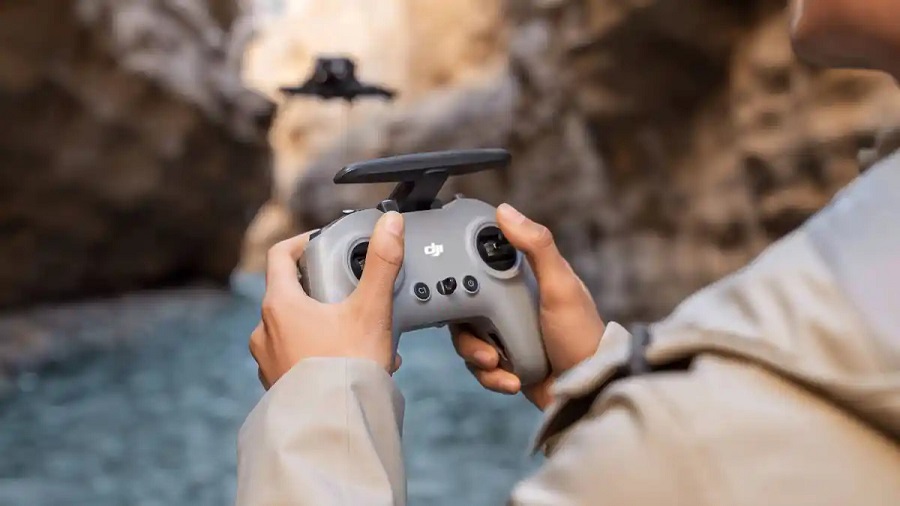
There are three different flight modes available for operating the Avata.
Normal (N) mode limits you to a speed of 28.8 km/h. It's easy to brake, while GPS plus GLONASS allow the drone to hover in place.
Sport (S) mode almost doubles the speed to 50.4 km/h.
Manual mode (M), which can only be activated with the FPV 2 remote control, increases the maximum speed to 96.5 km/h.
It is important to emphasize that you should practice with a simulator before entering M mode.
In N and S modes, you can still brake and let the drone hover in place.
M mode removes all flight restrictions and it is easy for beginners to get overwhelmed quickly if they are not adequately prepared.
Luckily, the new Turtle mode is here to help. If your drone happens to land on its back, you can flip it over without having to physically pick it up.
Find my Drone, a feature that helps you physically locate a lost or downed drone, is also a useful feature.
DJI's new offering taps into a market of people who want to fly FPV, but who may have been deterred in the past given the amount of technical effort required to make it happen.
The Avata is exciting to operate, and having an out-of-the-box solution is appealing. With a few improvements (particularly quieter operation), DJI could create an unbeatable FPV offering.
