

Mysterious lights on Mars, which resemble our own northern lights, have puzzled scientists for years. But now they have discovered what causes this phenomenon on the Red Planet.
See also: China: There was water on Mars much more recently than we thought

Auroras occur on Earth and many other celestial bodies when their magnetic fields collide with solar winds.
Mars, however, lacks a magnetic field, which has puzzled scientists about how the aurora appears.
It is believed that the planet had a global magnetic field at one point, which has now largely decayed.
Physicists led by the University of Iowa explored small pockets of solar magnetic fields on Mars.
These pockets help to produce auroras on Mars. This phenomenon is observed mainly in the planet.
Zachary Girazian, an author of the study, explained how the team created the first detailed study of how solar wind conditions affect auroras on Mars.
"Our key finding is that within the region of the strong crustal field, the rate of aurora occurrence depends mainly on the orientation of the solar wind magnetic field," he said.
«While outside the region of the strong crustal field, the occurrence rate depends mainly on the dynamic pressure of the solar wind.»
See also: NASA: Strange crater on Mars that is not round
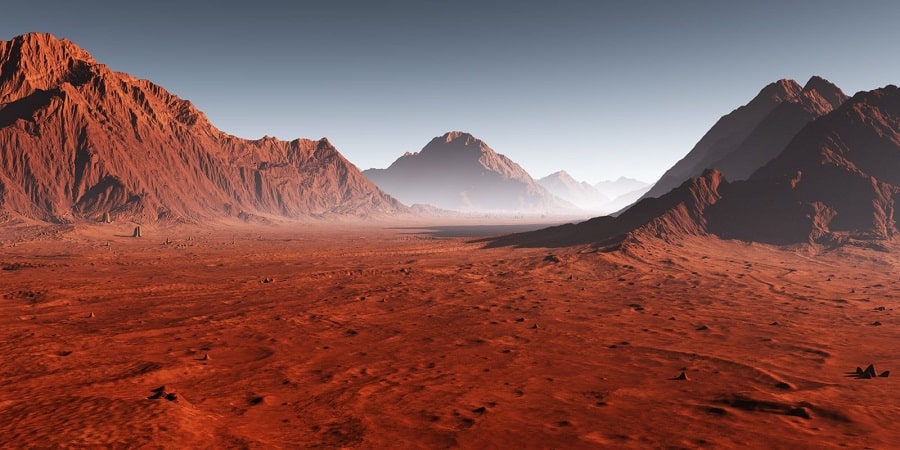
The team used data from more than 200 observations from NASA 's Mars Atmosphere and Volatile EvolutioN (MAVEN) spacecraft . MAVEN was launched in 2013 and has been used several times for research on Mars.
NASA's massive Mars mission has reached a critical stage in its search for signs of alien life. A six-wheeled robot that has been on the Red Planet for more than a year is about to climb into an ancient delta that could hold evidence of past life.
The Perseverance will hunt for rock samples it believes could provide crucial answers, using a drill. It will then head down, leaving the pieces at the base for collection on a later mission.
Space experts hope to bring the samples back to Earth for study sometime in the 2030s.
See also: NASA lost contact with its helicopter on Mars
Much of NASA's work has focused on a part of Mars known as Jezero, where Perseverance arrived in February 2021. So far, it has mainly conducted tests, along with the Ingenuity.
Scientists need to be sure where they plan to take samples, as they only have 43 collection tubes available. They hope to learn whether they contain ancient microbes and organic substances.
