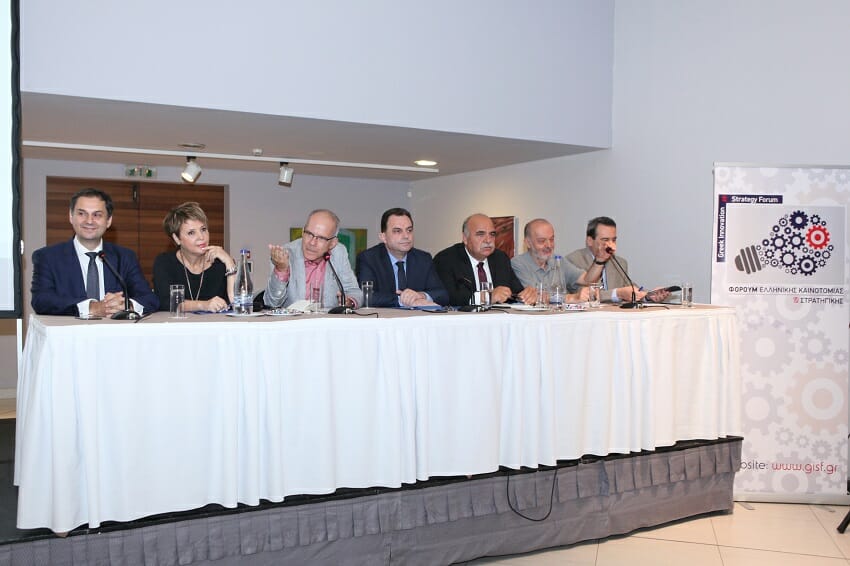
The Greek Innovation and Strategy Forum held its first event on the theme "Strategy for 21st Century Governance. In Search of Innovation. From Estonia to Greece" .
“When we tried to change the way of governance in Estonia, it was like the Indian fairy tale where in the dark someone searches with his hands what is around him. It was a new reality that we had to design,” pointed out former Estonian MP and founder of the Academy for Electronic Governance Mr. Ivar Tallo, who was the official guest and speaker of the event. “Information technology is based on design and interactivity of government services. However, in order to do this, computers were introduced in schools as early as 1997 with a partnership between the private and public sectors,” Mr. Tallo emphasized.
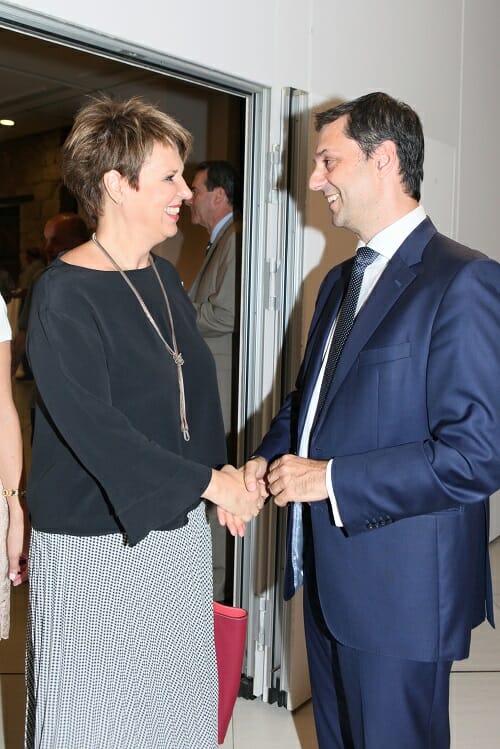
The Minister of Administrative Reconstruction, Mrs. Olga Gerovasili, spoke of "an excellent initiative that responds to one of the most important challenges of the 21st century, the interconnection of services and products."
He added that "the democratic control of citizens in the decision-making process is being consolidated. We have achieved a rapid increase in recent years in the use of new technologies. Today, approximately 7500 datasets have been posted on the Public Open Data Registry. We are now in 16th place in the EU-28, having risen 10 places since 2016." In the context of the event, the Independent Member of Parliament and Vice President of the Forum, Mr. Haris Theocharis, presented his proposal for the new digital public sector, proposing a leap in service through interoperability.
“We have the silo phenomenon in which each organization and each ministry claims its autonomy and the ability not to depend on anyone and not to communicate with anyone. However, this is not how high-quality services are built,” Mr. Theocharis observed. “Digital service must be established from the beginning with job descriptions, evaluation by citizens and goal setting. Let us take as a basis a web banking model, a gradual transition, bypassing the suspicion of citizens, a voluntary transition.
No reform will succeed without respect for those it affects. We must dare to envision. There is no technocratic solution to political problems. Political will is required. Today we must try higher and harder. Because when we are in a deep pit, it is not enough to aim low. We must throw the rope very high if we want to get out into the clearing.”.
"The benefits of e-government are spread to all citizens", pointed out for his part the MP and Head of the Administrative Reconstruction Sector of the New Democracy, Mr. Georgios Georgantas. "I am obliged to mention the progress in tax administration during the tenure of Haris Theocharis at the General Secretariat. It was an unattainable dream. We achieved results because there was the political will, because the technocratic and political personnel who served and supported the effort were found."
"It is wrong to consider e-government as an IT issue. IT is the tool that will help us change the way we operate, to change the procedures. We cannot adapt the Arab to the spaceship", underlined Mr. Pantelis Tzortzakis, former Deputy Minister of Administrative Reform, Vice President of QUEST HOLDINGS.
In his intervention Mr. Panagiotis Tsanakas, President of the National Research and Technology Network, pointed out that "in the history of humanity, e-government combines for the first time and strengthens Democracy, transparency in administration and efficiency".
"The most important positive element in the country is that 2/3 of civil servants are graduates. What is missing from the Greek public sector is management, because the administration is staffed according to customer criteria," noted Mr. Theodoros Karounos, Vice President of the Open Technologies Organization.
At the beginning of the event, a greeting was delivered by the President of the Governing Board of the University of West Attica and Honorary President of the Forum, Mr. Costas Moutzouris.