

In the first part of the article, we approached the concept of the internet and more specifically the dark web, a phenomenon that is of great concern to internet users. Now, we will attempt to delve deeper and study the issue in more detail, with the aim of identifying the dangers it hides.
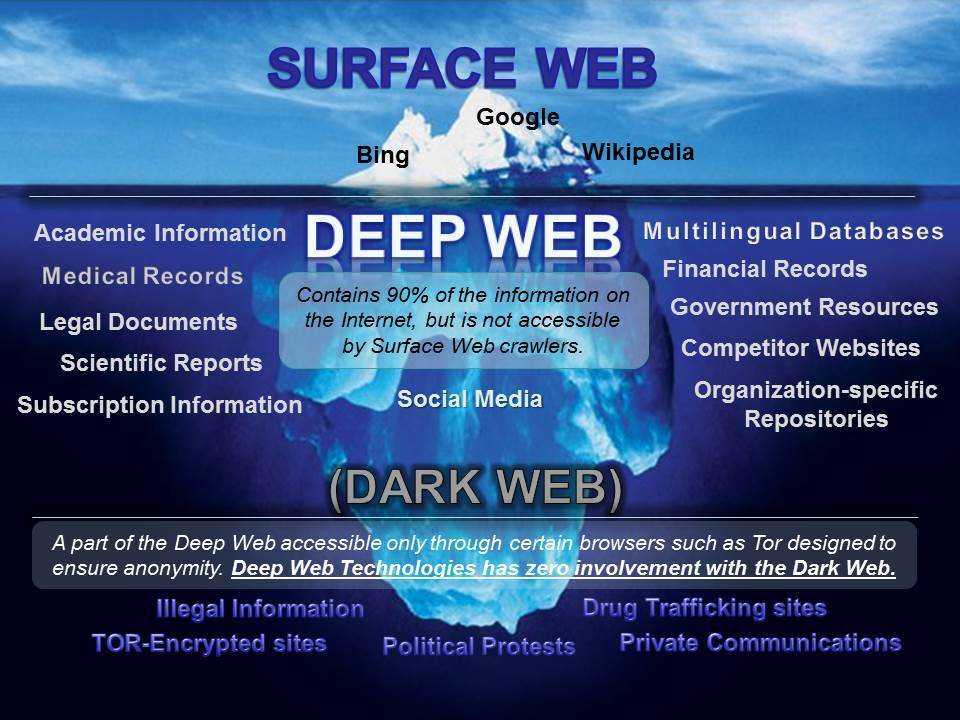
As we can see in the image, the internet visible to us, accessed by search engines, is likened only the tip of an iceberg. At the first part of the submerged iceberg is the Deep web, which consists of elements that we cannot locate through search engines, but only through navigating to specific websites. Finally, the Dark Web, which we cannot locate through the known search engines, nor through specific websites, is accessible only by using special browsers such as Tor.
What is Tor and how does it work?

The Tor (The Onion Routing) system, announced on 20/09/2002, provides its users with the ability to remain anonymous on the Internet. Specifically, Tor routes Internet traffic through a global volunteer network of servers that hides a user's location or traffic from anyone conducting online monitoring or analysis of Internet traffic.
“Onion routing” refers to the layered nature of the encryption service: the original data is encrypted and re-encrypted multiple times, then sent randomly through successive Tor nodes, each of which decrypts a “layer” of encryption before passing the data on to the next node and finally to its destination. The Tor network consists of Tor Nodes (nodes) operated by volunteer servers, thus serving Tor Clients (users).
How safe is it in reality?
The answer to this question is complex. If we want to use Tor we need to do several things to avoid problems. For example:
- We should not install any add-ons.
- We shouldn't download torrents.
- We should not type real information (names, addresses, etc.) anywhere.
- We should not put login details on websites.
- We should not download and install software.
- We should not send unencrypted data.
- We should not use the well-known search engines.
- We should not connect to the same server with and without TOR at the same time.
In short, we should not use old habits while surfing on Tor!

At this point it is worth emphasizing that although the use of Tor under normal circumstances does not constitute a legal violation, there is a possibility that its use may arouse suspicion among law enforcement agencies. Tor is occasionally targeted by government agencies, such as the NSA, the FBI, the EYP, etc., who have even in some serious cases and after organized attacks successfully managed to “uncover” some criminals. At the same time, the authorities are pushing for the enactment of laws that will give them more rights and freedoms on the network and its users.
Finally, to be precise, if a user acts illegally, they are very likely to face problems with the law, while it is important to know that in countries with repressive regimes, the use of Tor or other technology to achieve anonymity may be considered and/or be illegal. Therefore, special care is needed!
The only question that may remain is why someone would become a node and perhaps why you should become a node (tor relay); Stay tuned to SecNews and Part 3 may convince you.
f@pei
