

The last two posts regarding the free or non-free availability of Windows 10 clearly show the confusion that prevails in Microsoft's Licensing department. But let's see what happens next because the story doesn't end here.
In the Licensing section of each product, there are license agreements, which were drafted by large Microsoft legal teams, with separate terms for PC manufacturers and end users. 
These terms, along with very specific rights and responsibilities for each party to the license agreement, are
primarily aimed at Microsoft's business customers, PC manufacturers, and partners, who represent more than 98 percent of all Windows licensing revenue.
But there are also the unwritten rules. They are intended for hobbyists, Windows enthusiasts, and IT professionals who like to experiment with Windows and their computer hardware. Microsoft's TechNet program has been a long-standing gift to this group, offering thousands of dollars in Microsoft software at a fraction of the cost.
The Windows Insider program seems to follow the same spirit.
Every time Microsoft makes a public statement, it implicitly (and carefully) ratifies unwritten rules. That's what happened this week, with the announcement on Microsoft's official blog that Windows would be free for all registered members of Microsoft's Windows Insider program:
Windows Insiders running the Windows 10 Insider Preview (Home and Pro editions) with their registered MSA connected to their PC will receive the final release build of Windows 10 starting on July 29th. This will come as just another flight. I've gotten a lot of questions from Windows Insiders about how this will work if they clean installed from ISO. As long as you are running an Insider Preview build and connected with the MSA you used to register, you will receive the Windows 10 final release build and remain activated. Once you have successfully installed this build and activated, you will also be able to clean install on that PC from final media if you want to start over fresh.
What you will notice if you read the above paragraph carefully is that it does not contain any legal language. In fact, the word (license) does not appear anywhere in the text.
Update 1 June 21: Via Twitter, The Verge's Tom Warren points out that the post was changed overnight, adding and removing text to enable it. You can compare the changes in the text below: 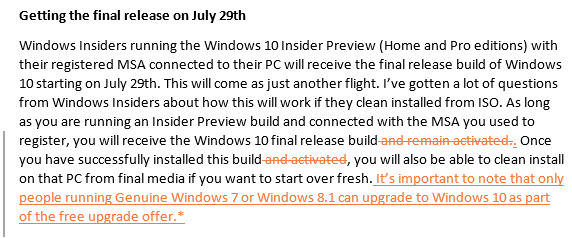
These changes, of course, only caused confusion, as the description clearly added legal terms. In fact, the last sentence contradicts everything that came before it.
According to ZDNet, however, we have had developments:
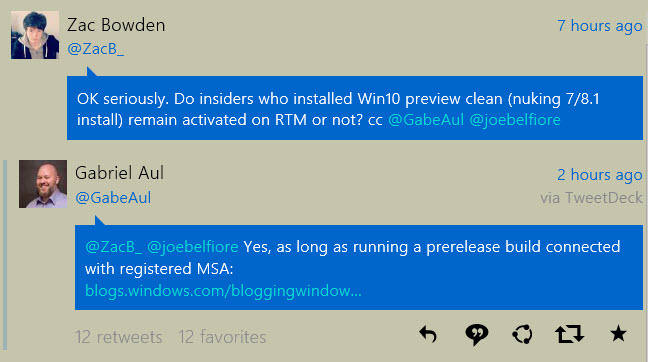
Update Two, June 21 12:15 PM PDT: On Twitter today, a day after the changes, Microsoft's Gabe Aul confirmed that registered Windows Insiders who upgrade from a clean install of the preview build will end up with a fully activated copy of Windows 10.
It's no coincidence that this post makes no mention of the Windows license. Instead, it's a reflection of the fact that the unwritten rules finally need to be written.
So, with a wink and a nod, people who are not PC builders or part of an enterprise network will be able to:
Yes, anyone who signs up for the Windows Insider program and installs a preview build will get the final version automatically, without any hassle or activation required.
Yes, this copy of Windows 10 will remain activated, even if it was installed cleanly (from ISO) with no traces of a previous version of Windows.
Yes, you will be able to perform a clean install of Windows 10 on this PC from official media (ISO) if you want to start from scratch.
And although there is a technical conflict with the terms of the license, you can relax. Microsoft is happy to have you on the Windows team.
Why is Microsoft doing this? I can think of a billion reasons.
Microsoft's stated goal is to get Windows 10 on one billion devices within three years of its launch. To achieve that massive number, it needs to convince hundreds of millions of current Windows users to upgrade.
Asking people to pay will certainly get a lot of no's. So the upgrade will be free for the vast majority of today's PC users.
You could think of it as a reward for the millions of users who have taken part in the Windows Insider program, but there's actually a much more practical reason:
It is simply not possible to do any kind of license for personal computers, and any attempt to do so will only cause friction. Likewise, any requirement for activation will cause friction.
Friction means that there will be too many disappointed people who will cancel the upgrade. Friction will prevent it from reaching its goal of one billion Windows 10 installations in the coming years.
So why not say, “Windows 10 is free”?
Businesses will still need to pay for Windows Enterprise licenses. PC manufacturers will still have to pay for their OEM copies.
The license terms for a new version of Windows don't usually appear until the last minute. The broad outlines rarely change, but Redmond's lawyers wanted to add their own twist to the company's initial announcement.
