

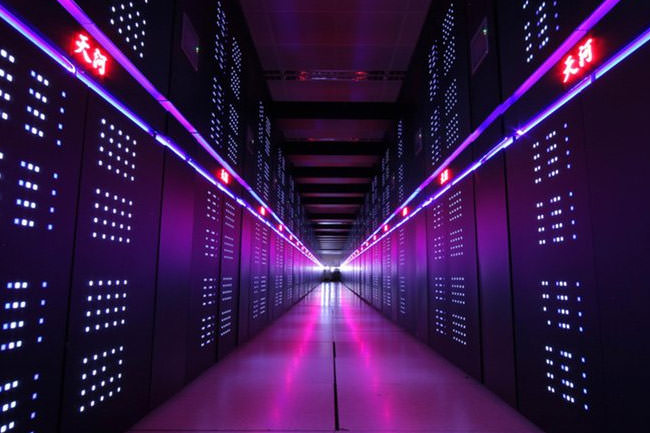
According In the latest Top500, which is updated twice a year, Tianhe-2 ("Galaxy-2") offers a power of 33.86 petaflops, that is, it can perform 33.6 quadrillion floating-point calculations per second. Since the previous edition of the Top500, China has managed to increase its supercomputers on the list from 63 to 76 - about as many as Britain (30), France (27) and Germany (23) combined. The US saw its share decrease by 15%, but remains by far the leader with 233 systems on the list. As for manufacturers, HP comes first with 182 systems, followed by IBM with 176 and Cray with 51. The champion Tianhe-2 It operates at the National Supercomputing Center in Guangzhou and is used in “research and education” programs. It uses a combination of Galaxy Ft-1500 processors designed at the university and Intel’s Ivy Bridge and Xenon Phi processors, and runs the Chinese operating system Kylin, which is based on Linux and designed specifically for high-end applications.
Tianhe-2's electricity requirements are monstrous, with consumption reaching 17.8 Megawatts, enough to power a small city.
High energy consumption was also the reason why IBM's Roadrunner, the system that first broke the 1 pflops barrier five years ago, was taken out of service in 2013.
In second place in the latest Top500, which is published by Professor Hans Moyer's team at the University of Mannheim in Germany, is again Titan (17.59 pflos), a Cray system operating at the Oak Ridge National Laboratory, which is part of the US Department of Defense.
Top500 performance is measured using the so-called Linpack test, which rates computers on how quickly they can execute a specific linear equation. However, it does not take into account other factors that affect speed in real-world conditions, such as the rate at which data is transferred from one part of the system to another.
The latest edition of the Top500 will be presented later Monday at the International Computer Congress taking place in Leipzig, Germany.
