

Extremely thin and light laptops or "hybrid" machines, which will have very long battery life, will not need any cables to operate and will "understand" the gestures of their user.
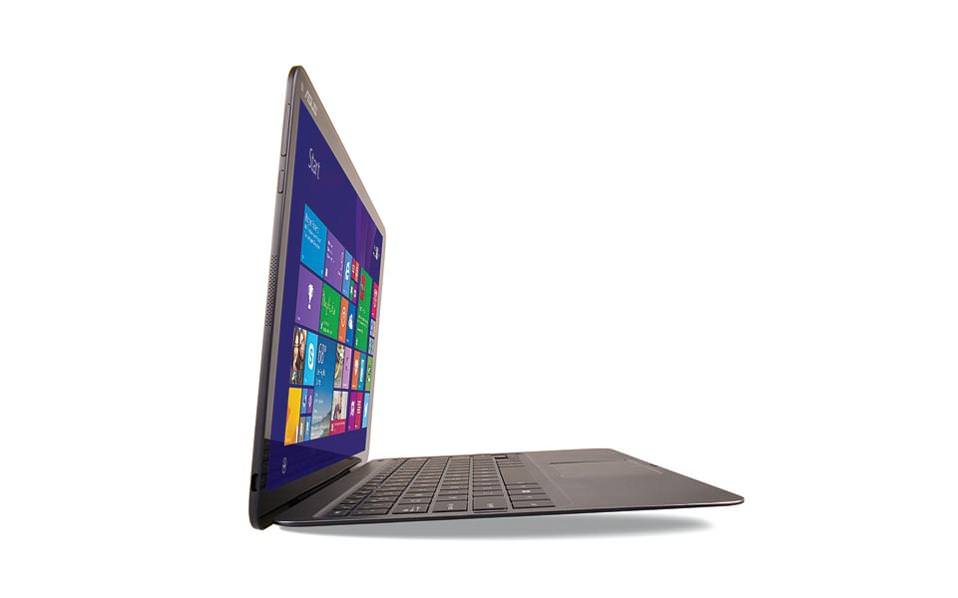
This is the future that several electronics companies have in the works for portable PCs, as evidenced by the prototype models and technologies they presented a few days ago in Taipei and Computex, the largest annual technology exhibition in Asia.
All of these companies are betting that, despite the increasing popularity of tablets, many users around the world will still need the features and performance of a notebook, which no tablet can offer. As it turns out, these consumers may not be enough to recover the PC market – for example, the analysis firm IDC predicts that PC sales will continue to decline over the next four years. Even so, the same firm estimates that in 2018, no less than 290 million computers will be sold worldwide.
Much earlier than 2018, and more specifically at the end of this year, portable PCs with Intel's fifth-generation (Broadwell) processors are expected to be commercially available, which will be impressively thin, since they will be cooled without a fan. An illustrative example is the 12.5-inch "hybrid" Transformer Book T300 Chi that Asus showed at the exhibition – which is just 7.2 millimeters thick when detached from its keyboard, and 14.3 millimeters with the keyboard. The Llama Mountain prototype that Intel presented at Computex also has the same thickness and screen size, also with a Broadwell processor, and weighs just 670 grams.
According to the American company, the benefits of the new "generation" CPU do not stop here, since they are combined with excellent speed and very low power consumption. In fact, in the case of Llama Mountain, Intel took even more advantage of the low energy requirements of Broadwell, "squeezing" two batteries into the computer screen. Thus, neither more nor less, this particular model has a "monstrous" autonomy, reaching 32 hours.
Although such models can be compared to tablets in terms of portability and long battery life, AMD and Texas Instruments aim to make them even more user-friendly by developing the DockPort protocol, which will put an end to the… tangle of cables that a computer needs. This is because one port will be enough to charge the machine and connect to hard drives, monitors, printers and other peripherals. The first applications of DockPort were presented at the exhibition, but they were overshadowed by Intel's revelation that the… next step will be for portable PCs to not need cables at all.
The company said that the first fully wireless models are expected in 2016, incorporating technologies that will allow them to communicate with any peripheral via electromagnetic waves. Their batteries will also be charged wirelessly, eliminating the need for a cable in this case. The technology is called Rezence and is being developed by the Alliance 4 Wireless Power (A4WP), a consortium that includes giants such as Dell, Fujitsu, Lenovo, Logitech, Panasonic, Asus, Logitech and Toshiba.
A4WP has recently developed the technology to be able to cover the energy needs of not only small gadgets, but also laptops. In fact, at Computex, it first demonstrated the capabilities of Rezence, hosting a wooden table at its booth that simultaneously charged a laptop, a mobile phone and a pair of headphones. The “wireless socket” was a base placed under the table, which could transfer energy to the devices, even though there was a 5-centimeter thick wood between them.
AMD also chose the Taipei show to give a preview of the ability of PCs with its new Kaveri processors to "see" the user's gestures through their cameras - e.g. to play games. The cameras being developed by Intel, on the other hand, can, in addition to gestures, perceive the owner's face in three dimensions, thus making the use of the face to unlock the computer more reliable.
3 machines 2 operational
While most of the prototype notebooks that made their appearance at Computex were based on Windows 8.1, the show was also full of machines that can switch between Microsoft's operating system and Google's Android. Undoubtedly the most impressive was Asus' Transformer Book V, which can be used in 5 different ways: as a tablet or laptop with Windows, as well as as a smartphone, tablet and laptop with Google's operating system.
The Transformer Book V consists of two parts, a 12.5'' "hybrid" machine with a detachable keyboard and Windows 8.1, and a 5.5-inch smartphone with Android. Its originality is that, in addition to using the two devices independently, one has the ability to place the smartphone in a slot on the back of the machine's screen. In this case, the "hybrid" model "borrows" the mobile operating system, functioning as a "tablet" or notebook with the Google platform.
Although with a less innovative design, the Taiwanese company has previously presented a model that combines the two operating systems, which, however, was never made available on the market. Asus did not specify when it will be released on the market and at what price. However, it seems to be one of the few major manufacturers that is betting on the idea, since the other corresponding models presented at Computex came from lesser-known Chinese manufacturers. In fact, in an interview during the exhibition, Dell spokesman Neil Hand ruled out any possibility that the American company would manufacture a model that supports both operating systems at the same time, claiming that it would not appeal to consumers.
Source: kathimerini.gr
