

In honor of Valentine's Day, Facebook has revealed something pretty creepy. With tons of data stored on its members, Facebook had a pretty good idea. It decided to use it to predict how long a romantic relationship between two people on the social network will last.
In a new study conducted by Facebook data scientist Bogdan State, he analyzed the relationships of Facebook users in the United States from 2008 to 2011.He found that the most important predictor of whether a relationship will last or not is how long the couple has been together.

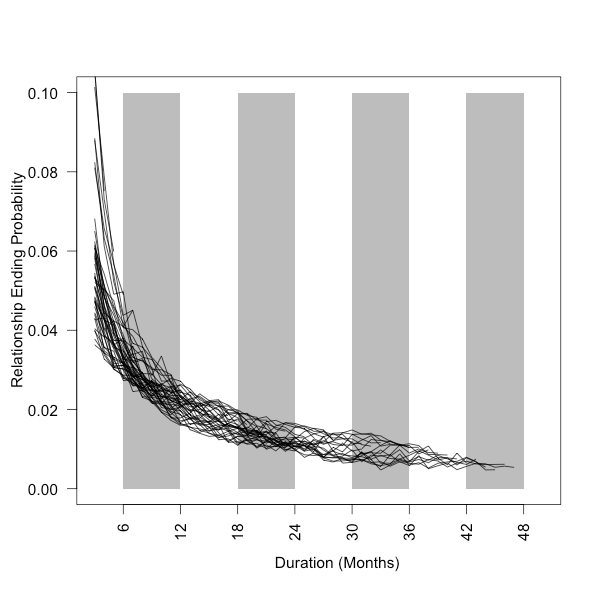
Bogdan State concluded that “about half of all Facebook that have survived more than three months are likely to survive four years or more,” which seems to make sense. As time goes on, volatile, casual romances end, leaving a higher percentage of strong, stable relationships.
The study focused exclusively on relationships that lasted at least three months and whose members were at least 23 years old. It also did not include anyone who was listed as “married.” The study did not take into account relationships that ended before three months and, of course, those who did not officially declare their relationship on Facebook.
Here is a graph showing the “estimated probability of a relationship surviving a certain duration, for relationships lasting three months or longer.”
The study also looked at breakup patterns, and found that relationships are most likely to end during the summer. Maybe it’s the academic calendar year, which takes people away from their partners for vacations, or maybe it’s the season itself. There was a spike in breakups in 2011. “It could be the recovery of the U.S. economy that coincided with the same time,” wonders State. I doubt it.
Facebook ’s penchant for trying to understand and predict human relationships dates back to its founder. According to David Kirkpatrick ’s 2010 book “ The Facebook Effect, ” Mark Zuckerberg , in his spare time, found that “by examining human relationships and communication patterns, he could determine with about 33% accuracy when a user was going to have a new relationship.”
