


Until now, many mathematicians believed that there were only 85 possible ways to tie a tie. But the knot favored by a stylish villain in the movie Matrix Reloaded has been found to defy the supposed rule. The real answer is now estimated at 177,147 different knots—even if many of them look like Gordian knots that no one would dare to wear.
Mikael Vegemo-Johansson, a mathematician at the Royal Institute of Technology in Stockholm, tells New Scientist magazine that he began studying the mathematics of knots when he saw a YouTube video about the tie of the "Merovingian", a character in the famous film.
He immediately realized that the unusual knot was absent from the list of possible knots that two mathematicians from the University of Cambridge, Thomas Fink and Yong Mao, had come up with.
In 1999, the two researchers published a mathematical "language" that describes tie knots in the journal Nature. Using tools from the field of logic, they described the basic rules of tying with symbols, and concluded that there are only 85 possible knots.
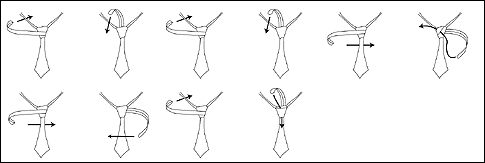
But they were clearly wrong. As Vegemo-Johansson found, his colleagues had relied on two assumptions that limited the strength of knots: First, the final movement in any knot is the creation of a fold with one end of the tie passing through the rest of the knot. Second, all knots are covered by a flat piece of fabric without folds.
In order to expand the mathematical definition, Vegemo-Johansson simplified the process and described the tying movements as clockwise or counterclockwise rotations of the tie around the freely hanging end.
In addition, he changed a basic rule regarding how many moves one can make before the tie looks too short. Fink and Yong set the limit at 8 moves, Vegdemo-Johansson raised it to 11.
And counting all possible moves before reaching this limit yielded 177,147 possible knots, which can be viewed in random order on a website created by the researcher.
Vegdemo-Johansson himself has now abandoned traditional knots in favor of more elaborate ones.
His study, titled More Knots Than We Thought, is available on the arXiv preprint service.
Source: in.gr
