

An experimental laser communication system being tested on NASA's latest mission to the Moon has set a new record for extraterrestrial transmissions at 622 Mbps. This means that future NASA missions will be able to transmit high-definition and 3D video. The LADEE spacecraft aimed a laser beam at a ground station in the US (Photo: NASA ) Almost all space missions today rely on radio communications, but these have significant limitations. One problem is that the electromagnetic spectrum is not unlimited, and the frequencies corresponding to radio waves and microwaves are now occupied. But NASA needs faster and faster transmissions, and a good solution is to exploit laser radiation in other, wider frequencies.
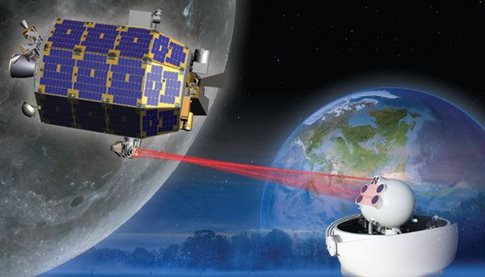
Laser communication is now being tested on the LADEE mission, which recently orbited the Moon. The craft communicates via a laser beam with a station in New Mexico.
The 622 Mbps speed "is six times faster than the last radio communication system on the Moon," said Don Cornwell, coordinator of the Lunar Laser Communication Demonstration (LLCD).
"The 622 Mbps bandwidth would support 30 high-definition channels," he added.
The next test of the technology is scheduled for 2017, when a geostationary satellite will be launched that will act as a relay for the station in New Mexico to communicate with a second station in California.
Curated by: Vangelis Pratikakis
