

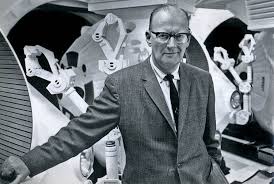
 In the distant, now 1964, the British science fiction writer, Arthur Clarke, appeared on the BBC and described a future world where communications would be possible between the whole world, thanks to satellites. At the same time, he spoke briefly about the upcoming wonders of telemedicine and teleworking. Being an expert in radar and communications himself, it is not surprising that his predictions for the future world concerned mainly the field of communications. What is surprising, however, is that unlike other futurists who spoke of flying cars and the universal prevalence of robots, the pioneering writer managed to foresee the future world with incredible accuracy, giving special emphasis to communications, which turned out to be accurate.
The best proof of this is none other than an interview Arthur Clarke gave in 1976 and released by AT&T in January. In this conversation, the author of "A Space Odyssey" predicts almost everything about communications in the future world: from the internet to smartphones and "smart" watches.
Below you can read the 8 most important predictions that Clark made 39 years ago and today are already a reality..
Computers

Speaking at an AT&T/MIT conference, Arthur Clarke outlined his vision for the future. The author of "A Space Odyssey" described the possibility of communicating with the outside world using high-resolution screens connected to a keyboard.
In short, Clark managed to accurately describe the home computers of the coming years!
Video calls

Like many futurists, Arthur Clarke, irritated by the low quality of telephone calls that were the main means of direct communication at the time, envisioned video calls.
Several decades later, Skype popularized video calling, allowing us to easily see and talk to people even on the other side of the world.
Internet

Decades before the internet became everyone's property, Arthur Clarke described how interconnected devices "will enable us to send much more information to our friends... to exchange pictures, graphics, data, books and much more.".
The internet has now entered the lives of most people, allowing us to communicate and exchange data with extreme ease.

Back in 1976, the primary means of communication were the telephone and traditional mail. However, Clark had the foresight to foresee not only real-time communication, but also the arrival of email.
Today, email communication is so taken for granted that our email address accompanies our basic personal information. On the other hand, new instant messaging services are constantly popping up, competing for a spot on the home screen of our “smart” devices.

Arthur Clarke imagined a “machine” that would search data in a “central library” to bring us exactly the information we were looking for, whether it was news, football scores or flight details. If we assume that the internet is the library Clarke was talking about, then we could logically think that his machine is none other than the algorithm of Google, Bing or other search engines.
Mobile phones

Clark not only predicted the existence of mobile phones, something not particularly impressive since the technology already existed in his time, but he also saw how mobile devices would "restructure society.".
We are currently in the stage of precisely this "reconstruction", as portable devices proliferate, surpassing the traditional mobile phone and bringing a full computer to our pocket..
Teleworking
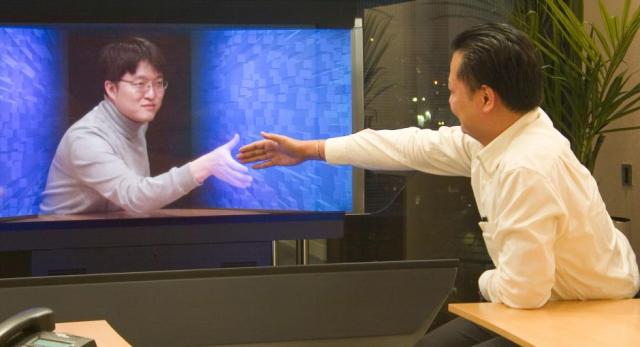
The science fiction writer imagined that in the future, travel would be done exclusively for fun, as everything else would be done via telecommunications.
Although video conferencing has not become widespread, let us just think that serious decisions concerning states can be made via video conferencing (e.g. Eurogroup video conferencing decisions). Furthermore, there are quite a few people who work without ever being in their office.
"Smart" watches
N
Like several other visionaries, Arthur Clarke predicted that the "smart devices" we wear on our hands would become a reality in the future, even though at the time they were only in the imagination of artists, such as the creator of the comic strip "Dick Tracy.".
Some 40 years later, smartwatches are with us and their owners can call a taxi by touching the device on their wrist!
