

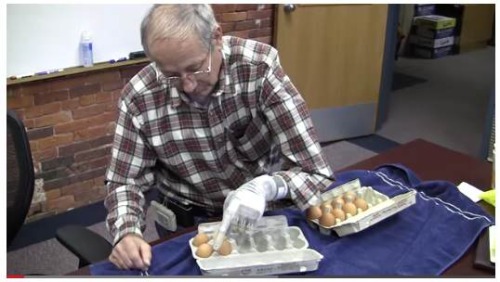
 The era of true cyborgs has begun. The U.S. Food and Drug Administration (FDA) has given the first approval for the sale and marketing of a prosthetic hand that translates signals from a person's muscles.
Unofficially known as the “Luke” arm (a reference to robotic arm in Star Wars), the Deka Arm, which is controlled by electrical signals from electromyography (EMG) electrodes attached to the wearer’s muscles, may now move from experimental research to a full-fledged commercial product. It’s true, bionic limbs are ready for the market.
“The Deka Arm System may allow some people to perform more complex tasks than they could with existing prosthetic limbs, in a way that more closely resembles natural arm movement,” said Christy Foreman, director of the Office of Device Evaluation in the FDA’s Center for Radiological Health.
In a demonstration video released Friday, Fred Downs, one of the Deka Arm recipients, is shown using the prosthetic hand to gently pick up and open a carton of eggs. Like the device's nickname, its presentation is indeed reminiscent of the dexterity of robotic arm, a technology that was pure science fiction just a few decades ago when the film was first released.
The Deka Arm's electrodes, attached to the user's muscles, transmit signals to a processor in the prosthetic limb, which then interprets these signals and converts them into up to 10 distinct movements.
In yet another video, Downs is shown using the Deka Arm to open a mail envelope, a seemingly simple demonstration that is nevertheless indicative of the device's accuracy.
And while the project is funded by the Defense Advanced Research Projects Agency (DARPA) and the U.S. Army Research Office, Dean Kamen, the inventor of the Segway, and his team at Deka Research played a pivotal role in its development, hence the name.
The commercialization of advanced prosthetic limbs would be good news for everyone from injured military veterans to accident victims. However, the Deka Arm does not work for those with limb loss at the elbow or wrist.
