

AI Agents are one of the biggest trends in artificial intelligence today, as companies turn to digital assistants that can perform complex tasks autonomously, rather than simply answering questions. In this environment, OpenClaw is attempting to strengthen its presence by introducing a new mobile application for Android and iOS, which gives users the ability to interact with their personal AI agents from anywhere.
The app acts as an extension of the OpenClaw private gateway, allowing secure access to system functions via smartphone. This way, users can manage automations, approve actions, and chat with their AI assistant even when they are away from their computer.
The main features of the OpenClaw app for iOS and Android
According to OpenClaw, the application was designed to transform the mobile phone into a secure communication hub with the user's personal AI environment.
See also: Nvidia turns OpenClaw into NemoClaw enterprise platform
Connection to the private OpenClaw Gateway is made via QR Code or a special installation code, while from there the user gains access to functions such as chat with the assistant, real-time voice communication, push-to-talk, as well as remote approval of actions requested by the platform's automations.
At the same time, the application can – if the user allows it – leverage capabilities of the device itself, such as the camera, location, screen and notifications, offering smarter and more personalized automations. In addition, it supports real-time notifications and updates on the status of connected workflows.
For those already using the OpenClaw ecosystem, the application is expected to be a particularly useful tool, as it transfers almost all of the platform's basic functions to mobile.
The design provokes reactions
Although the application's capabilities are considered interesting, its aesthetics seem not to have particularly impressed the community.
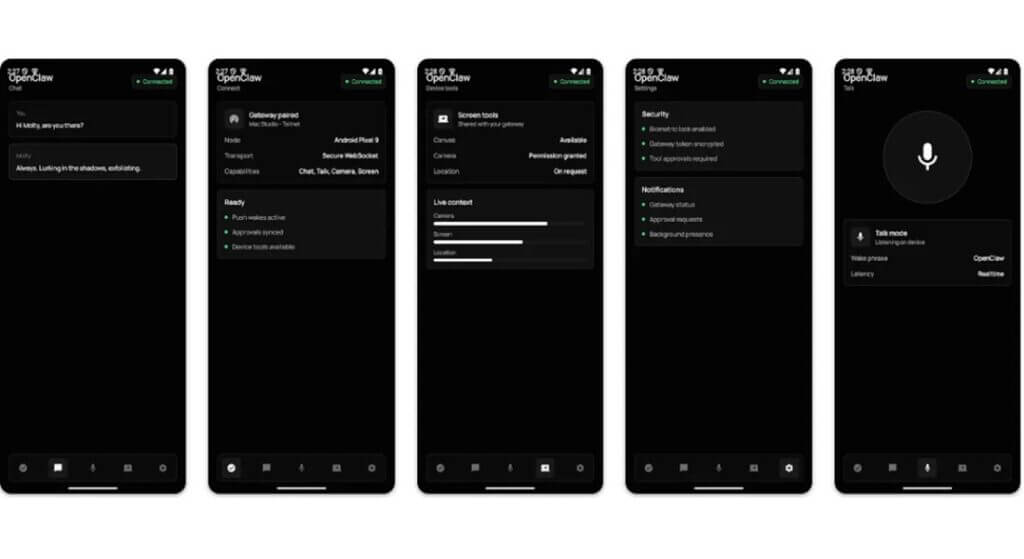
Official screenshots published on Google Play show a particularly sparse interface, with several users commenting that it looks more like a trial version than a full-fledged commercial product. In some cases, the app's header appears to overlap with Android's status, creating an image that doesn't meet modern design standards.
See also: Prosus launches ToqanClaw, an OpenClaw-like tool for its 5 million merchants
Although those who have tried the app on devices like the Galaxy Z Fold 7 report that the experience is noticeably better than the screenshots show, the first image seems to have significantly influenced impressions.
Low rating and strong criticism
But beyond appearance, early reviews on Google Play reveal that several users are also experiencing functional issues. The app has a rating of around 2.2 stars, with several reviews reporting failed attempts to connect to the OpenClaw Gateway, difficulties in the pairing process, and bugs that limit the usability of the app.
Some users have described the experience as disappointing, citing lack of functionality and a feeling that the software was released before its development was complete. Although the first days of an application's release are often accompanied by technical issues, the picture emerging so far shows that OpenClaw has a lot of work ahead of it.
Functionality remains the main advantage
Of course, those who know OpenClaw point out that the company has always prioritized functionality over appearance. OpenClaw itself is based primarily on a environment command-line and macOS, aimed primarily at advanced users and developers who are more interested in automation capabilities than in the design of the environment.
See also: Apple may develop an OpenClaw competitor in the future
However, the advent of mobile platforms is changing the game. Users now expect applications that combine powerful features with modern design, stability, and an easy-to-use experience.
OpenClaw is taking a significant step towards AI agents that work anywhere, anytime. However, the first version of the app shows that there is still a lot of room for improvement. As long as the company responds quickly to community feedback and fixes the problems that have been identified, the app could become a particularly useful tool for those investing in the capabilities of the next generation of intelligent digital assistants.
