

AMD today announced that 3D V-Cache technology will be integrated for the first time into the new Ryzen PRO 9000 processors , extending the innovative technology from gaming processors to professional workstations. This strategic move marks a significant shift in the company’s approach, as 3D V-Cache is no longer considered exclusively a gaming technology. This decision reflects the growing demand for high performance in professional environments that handle large volumes of data and complex calculations.
See also: Ryzen 9 9950X: AMD's first Zen 5 CPU is a "monster"
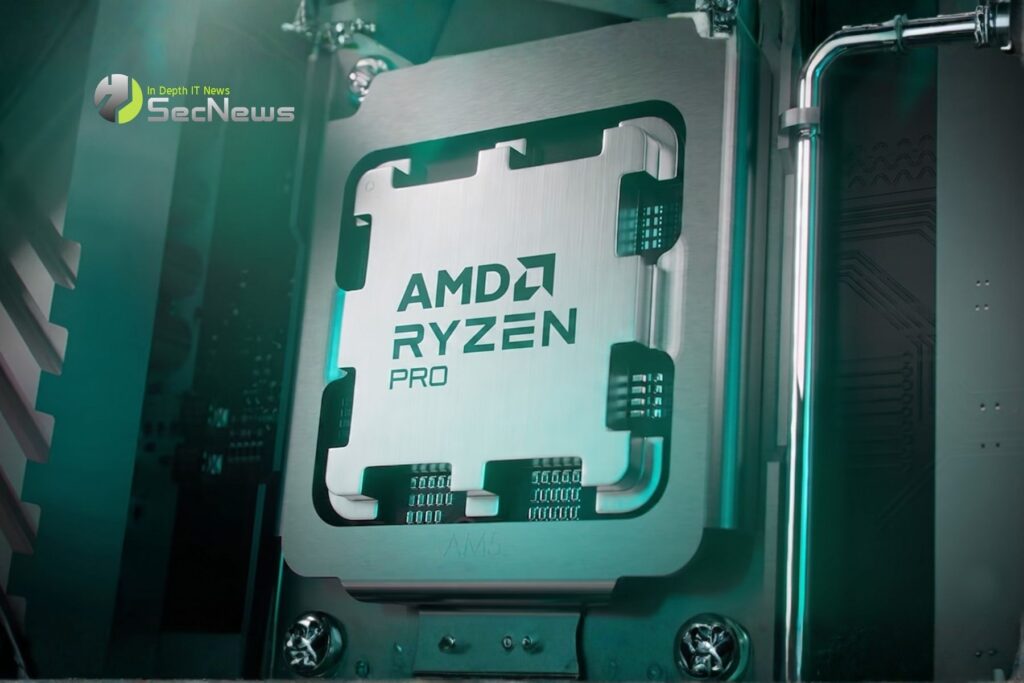
AMD 's 3D V-Cache technology first appeared in 2022 with the Ryzen 7 5800X3D , delivering revolutionary gaming performance by stacking additional L3 cache vertically on the processor. The second-generation 3D V-Cache used in the new processors offers improved thermal behavior and higher operating frequencies, making it ideal for professional applications. This development was the result of extensive research and development, with AMD investing significant resources in improving the architecture and manufacturing process.
According to AMD, 3D V-Cache will be particularly useful for “complex, data-intensive workloads such as simulation, rendering, and real-time visualization.” This represents a significant expansion of the technology’s utility beyond gaming, targeting professionals who need high performance in applications such as CAD, 3D modeling, and scientific computing. The large cache capacity drastically reduces memory access latencies, which is critical for applications that process large datasets or execute complex algorithms in real time.
Technical specifications of the new Ryzen PRO 9000 with 3D V-Cache
The updated Ryzen PRO 9000 series is based on AMD ’s Zen 5 architecture and includes processors with 6 to 16 cores and 12 to 32 threads . The new processors support up to 256GB of ECC DDR5 memory and offer full support for PCIe 5.0 , ensuring future compatibility with the most demanding applications. ECC memory support is especially important for professional applications that require absolute reliability and accuracy in calculations, such as financial models, scientific simulations and mission-critical databases.
The specific models that will feature 3D V-Cache include the Ryzen 9 Pro 9965X3D with 16 cores and 128MB L3 cache, as well as the Ryzen 7 Pro 9755X3D with 8 cores and 96MB L3 cache. These cache amounts are significantly larger than traditional processors, offering a drastic reduction in data access latency. The TSV (Through-Silicon Vias) architecture used to connect the cache layers ensures high communication speed and minimal latency.
AMD claims that the new generation of 3D V-Cache offers a 16% improvement in IPC (Instructions Per Clock) compared to the previous architecture, while some models can achieve 400MHz higher boost frequencies than their previous generation counterparts. Improved thermal management allows the processors to maintain high frequencies for longer periods of time, which is critical for sustained workloads that last for hours.
See also: Boost your PC with the AMD Ryzen 5 5500 CPU
Practical applications and benefits for professional users
Professionals who will benefit most from 3D V-Cache include architects using BIM software, engineers performing FEA simulations, and content creators working with 4K/8K video editing. The large cache also helps in machine learning inference and data analytics, where fast access to large datasets is critical. Additionally, developers compiling large codebases will see significant improvements in build times, while database administrators will enjoy faster queries on in-memory databases.
Impact on the workstation market and competition
AMD 's move to bring 3D V-Cache to workstations represents a direct challenge to Intel , which lacks a comparable cache-stacking technology in its mainstream desktop products. Intel has focused on hybrid architectures and built-in AI acceleration , but AMD is gaining ground with its innovative approach to cache memory. This competition is expected to lead to further innovations from both companies, to the benefit of consumers and professional users.
The workstation market, although smaller than the consumer market, is particularly lucrative due to higher prices and specialized requirements. Professional users are increasingly looking for solutions that can handle local AI workloads, real-time rendering, and complex simulations without the need for separate accelerator cards. The trend toward the “AI PC” era makes high cache capacity even more important, as many AI applications depend on fast data access.
See also: First look at the new AMD Ryzen PRO 8840 & PRO 8000G Series
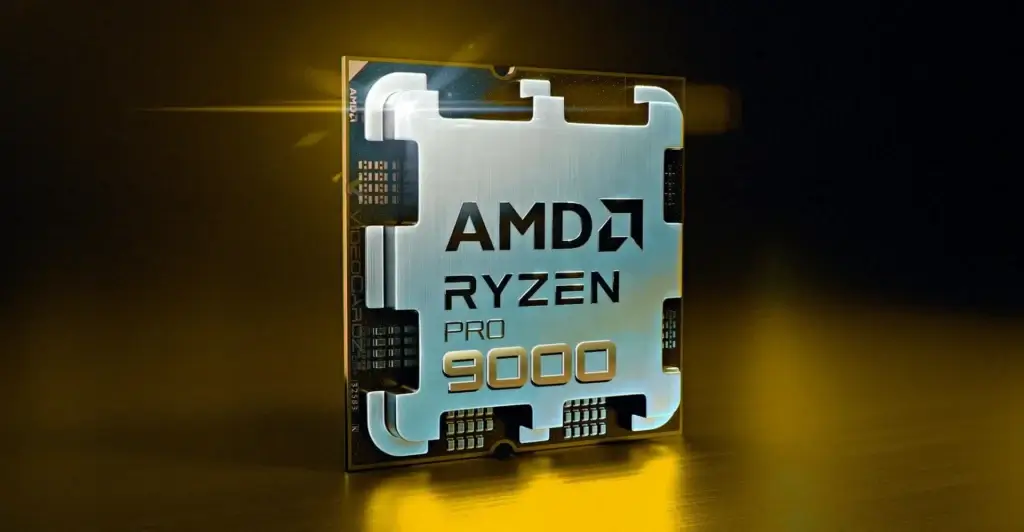
The expansion of 3D V-Cache to workstations reflects AMD 's broader strategy to establish the technology as a core feature of its premium processors, regardless of the application. This could lead to further innovations and improvements in cache memory as the company invests more in this direction. In the long term, AMD aims to make 3D V-Cache a standard feature across its high-end series, creating a clear competitive advantage over traditional architectures.
