

A startling scientific discovery appears to be changing what we know about the origins of our planet. A team of researchers from MIT and partner universities announced that they have detected traces of material from the so-called early Earth, or proto-Earth, the primordial version of our planet that existed before the collision that created the Moon.
The study, published in the journal Nature Geoscience, suggests that tiny chemical remnants from that era have survived deep within the Earth almost unchanged for more than 4 billion years. It is one of the first direct evidence that materials from the early Earth still exist in the planet's interior.
The Earth before the Moon: A world of fire and conflict
To understand the significance of the discovery, we need to go back about 4.5 billion years. The solar system was then a chaotic cloud of gas and dust. From this mixture the first planets and asteroids, including a young, fiery version of Earth – the so-called early Earth.
See also: Uranus – Neptune: Maybe they're not as "frozen" as we think!
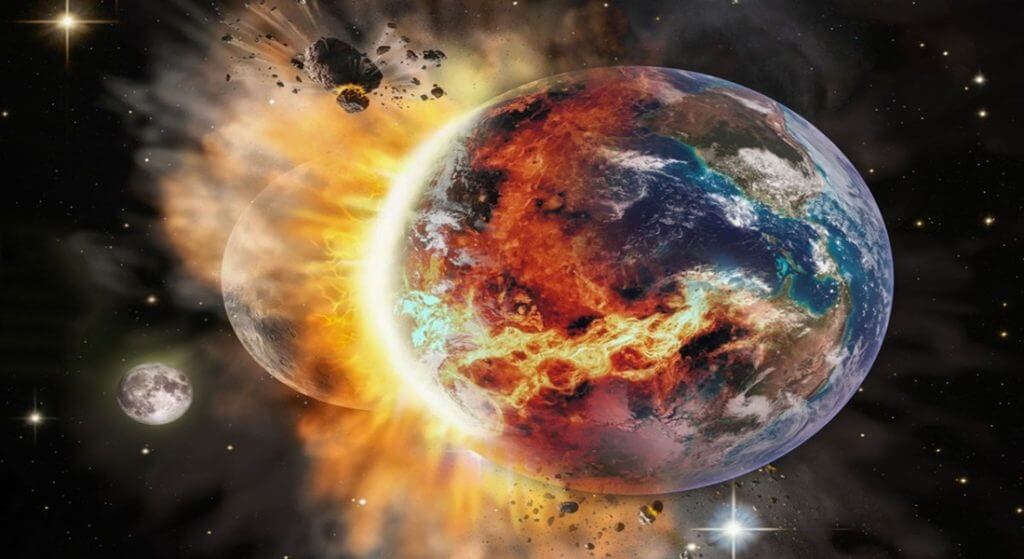
Less than 100 million years later, a Mars-sized asteroid violently collided with it. The impact was so devastating that it melted and reshaped almost the entire planet, while the debris from the collision coalesced to form the Moon.
Scientists thought that this giant impact wiped out all traces of the original planetary material. But the new study shows that a small percentage of this primordial matter may have survived, buried deep in the Earth's mantle.
The "footprint" of potassium: A chemical message from the past
Professor Nicole Nie 's team detected a tiny but distinct deficiency of the isotope potassium-40 in ancient rocks from Greenland, Canada and Hawaii. This phenomenon, known as an isotopic anomaly , could not be explained by known geological processes.
Potassium exists in three forms – potassium-39, potassium-40 and potassium-41. Their ratios offer valuable clues about the origin of a rock. The unusual ratio found in the samples suggests that it is material that predates the lunar impact.
As Nie explains: "We're seeing a piece of the very ancient Earth, even before the giant impact. It's incredible how this signature has managed to be preserved."
See also: The James Webb Telescope may have spotted "dark stars" in the distant universe
The process: From Greenland to the spectrometer
To identify this subtle chemical imbalance, the researchers dissolved the rocks in acid, isolated the potassium, and measured the isotopes with an ultrasensitive mass spectrometer. They also created computer simulations to compare the results with theoretical models of planetary collisions.
In all models, the result was similar: the simulated compositions had more potassium-40 than the real samples. This means that the Earth rocks studied contained material “untouched” by the collision, a kind of geological fossil of the Earth’s own formation.
Material from the early Earth: What it means for science
The discovery opens new avenues in planetary geochemistry and astronomy. If confirmed, it could help scientists rewrite the early chapters of Earth's history and understand form rocky planets.
The study also suggests that the existing sample of meteorites that researchers use to reconstruct the early chemistry of the solar system is inadequate. As Nie points out:
«Our work shows that there are still unknown building blocks of our planet. The meteorite record doesn't tell the whole story».
See also: Invisible asteroids around Venus may threaten Earth

A new window into the distant past
The idea of an early Earth, or proto-Earth, is not new — but for the first time, there is tangible evidence that materials from this period have survived. If confirmed by further research, this discovery could explain a lot about our planet and the Moon.
Beyond its purely scientific value, the discovery also has a deeply human dimension: it reminds us that pieces of the original, wild Earth still exist beneath our feet, like silent witnesses to the planet's genesis.
And as is often the case in science, each answer raises new questions: how much of this primordial material remains untouched? And what else can it tell us about our place in the solar system?
