

A remarkable burst of energy that emerged from a nearby galaxy in December 2021, lasting just 50 seconds, caught the attention of scientists. After extensive research and prolonged examination of the data, they finally revealed why this event occurred. The intense surge of energy felt on Earth appears to have been the result of the collision of two neutron stars and the subsequent explosion and merger.
Understanding the origin of the phenomenon called GRB 211211A has been a priority for astronomers because it could help change our understanding of the universe.
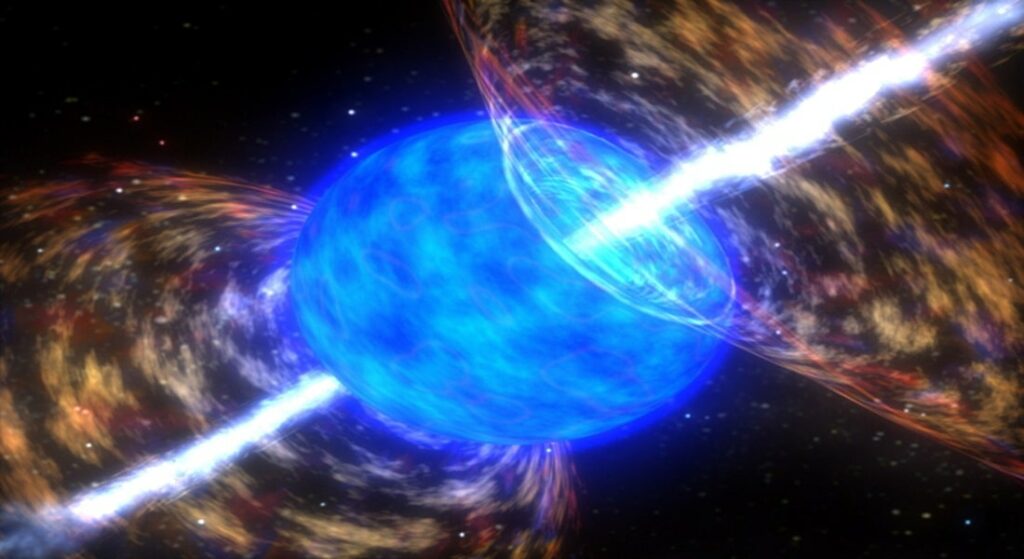
Researchers examining archival observations of gamma rays say they have found "oscillating" signals in two bursts of energy.
See also: Watch the first launch of SpaceX's Falcon 9 for 2023!
They were discovered in old files obtained from an abandoned experiment in orbit around our planet.
According to experts, the explosions exhibit characteristics that suggest that two neutron stars have merged into a single massive star.
Neutron stars are an incredible phenomenon that amazes us with their properties each time we study them further. From their extreme mass density to the strong magnetic fields and rapid rotations, there are no properties lacking that inspire awe and make them so unique and valuable in astronomical research.
Neutron stars are the dense cores left behind when massive stars reach the end of their lives. When two such objects collide, more massive neutron stars can form, which usually collapse under their own mass to form a black hole.
See also: Water on the Moon? Tests of extracting water from lunar rocks
Researchers studying the phenomenon called GRB 211211A showed through simulations that the presence of large neutron stars can be determined by certain types of gamma-ray bursts that come from their collisions. And so the researchers , led by University of Maryland scientist Cecilia Chirenti, examined 700 gamma-ray observations for these specific “fingerprints.”
Scientists have discovered two such candidates. Named GRB 910711 and GRB 931101B, they have the kind of frequencies that scientists had predicted would occur during neutron star mergers.
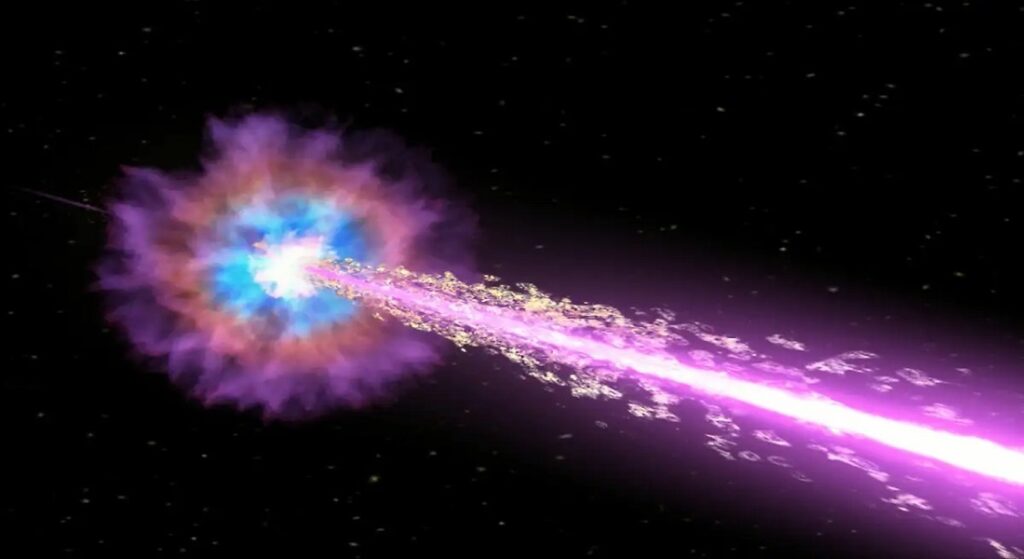
Both examples were found using BATSE , or the Burst and Transient Source Experiment. This was used to study gamma-ray bursts. However, it also recorded other data from orbit around Earth. It did so until 2000. NASA brought it down to Earth and destroyed it, ending its nine-year mission. Fortunately, though, scientists still have access to data , and they do so in the hope of finding new data.
See also: Pentagon UFO: Reports of aliens have not been confirmed
It's worth noting that scientists also looked at data from other gamma-ray detectors. However, BATSE was the one that led to the successful detections, due to its design.
Scientists hope that this is the beginning of a new way of studying neutron star mergers.
The above findings are reported in detail in a new paper, “Kilohertz quasiperiodic oscillations in short gamma-ray bursts”, published in the scientific journal Nature.
Source: www.independent.co.uk
