

Armis has discovered five vulnerabilities in the implementation of TLS communications in multiple Aruba and Avaya switch models. The vulnerabilities stem from a similar design flaw identified in the TLStorm vulnerabilities (discovered earlier this year by Armis) and extend the reach of TLStorm to potentially millions of additional enterprise-grade network infrastructure devices.
See also: The REvil ransomware group is back with a vengeance

Security researchers have discovered five vulnerabilities in network equipment from Aruba (owned by HP) and Avaya (owned by ExtremeNetworks), which could allow malicious actors to remotely execute code on the devices.
The damage caused by a successful attack ranges from data breach and complete device takeover to lateral movement and overriding network segmentation defenses.
Security researchers from cybersecurity firm Armis, which specializes in connected devices, named the vulnerability set “TLStorm 2.0,” as the discovery falls into the same category of issues as the NanoSSL TLS library misuse, which they reported in popular APC UPS models.
See also: Sixt: Car rental company suffered a cyberattack
Analysts found that devices from other vendors have identical security risks and provided a list of affected products:
- Avaya ERS3500
- Avaya ERS3600
- Avaya ERS4900
- Avaya ERS5900
- Aruba 5400R Series
- Aruba 3810 Series
- Aruba 2920 Series
- Aruba 2930F Series
- Aruba 2930M Series
- Aruba 2530 Series
- Aruba 2540 Series
External libraries on switches
Network switches are common elements in corporate networks, helping to enforce segmentation, a security practice that is fundamental to larger environments.
Their role is to act as a network bridge, connecting devices to the network and using packet switching and MAC addresses to receive and forward data to the destination device.
Using external libraries is often a convenient and cost-effective solution, but sometimes this comes with application errors and security issues.
This practice motivates hackers to look into these tiny building blocks to find potentially exploitable flaws.
In the case of TLStorm 2.0, the cause of the issue is that the “glue logic” code used by vendors does not comply with NanoSSL guidelines, leading to potential RCE (remote code execution).
See also: Google SMTP relay service sends phishing emails
At Aruba, NanoSSL is used for the Radius authentication server and captive portal system. The way it has been implemented can lead to heap overflows of attacker data, which are tracked as CVE-2022-23677 and CVE-2022-23676.
In Avaya, the library implementation introduces three flaws, a TLS decompilation heap overflow (CVE-2022-29860), an HTTP header parsing heap overflow (CVE-2022-29861), and an HTTP POST request handling heap overflow.
The problems arise from lack of error checking, missing validation steps, and improper boundary checks.
These issues are not in the library itself but in the way the vendor implemented it
Attack scenarios
Armis presents two key exploitation scenarios that allow for the escape of a captive portal or the breach of network segmentation, which pave the way for cyberattacks .
In a captive portal scenario, the attacker gains access to a restricted network resource's web page that requires authentication, payment, or some other form of access token. These captive portals are typically found in hotel networks, airports, and business centers.
By exploiting TLStorm 2.0, the attacker can remotely execute code on the switch, bypassing the captive portal restrictions or even disabling it completely.
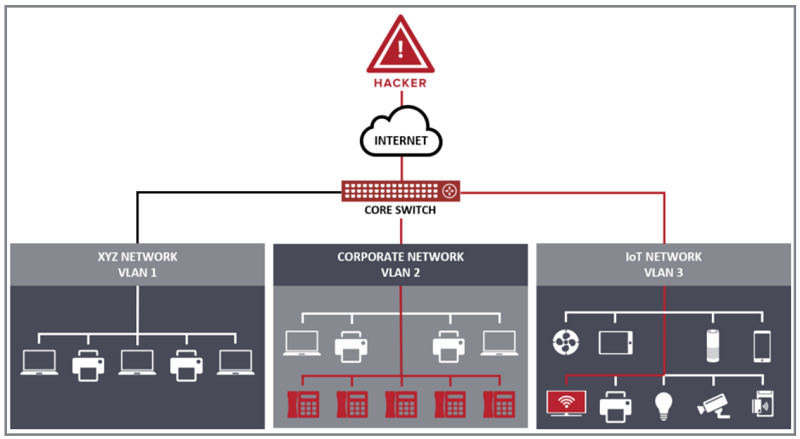
In the second scenario, an attacker can use the vulnerabilities to break network segmentation and gain access to any part of the IT network, freely rotating from the “guest” space to the “corporate” part.
Restoration
Armis notified Aruba and Avaya of the TLStorm 2.0 vulnerabilities three months ago and worked with them on a technical level.
Threat analysts told BleepingComputer that affected customers have been notified and patches have been issued that address most of the vulnerabilities.
Information source: bleepingcomputer.com
