

In a previous post, we mentioned Wi-Fi 6, the next-generation wireless standard that's faster than 802.11ac. But in addition to speed, it will provide better performance in congested areas, from stadiums to your home. We'll see it in 2019.
Wi-Fi as we mentioned yesterday has version numbers! Even old Wi-Fi names like “802.11ac” have been renamed to user-friendly names like “Wi-Fi 5.”
Here are the versions of Wi-Fi:
Wi-Fi 4 is 802.11n, released in 2009.
Wi-Fi 5 is 802.11ac, released in 2014.
Wi-Fi 6 is the new version, also known as 802.11ax. It will be released in 2019.
But older versions of Wi-Fi that are not widely used also acquired a name:
Wi-Fi 1 is 802.11b, released in 1999.
Wi-Fi 2 is 802.11a, also released in 1999.
Wi-Fi 3 is 802.11g, released in 2003.
Faster Wi-Fi
As usual, the latest Wi-Fi standard offers faster data transfer speeds. If you're using a Wi-Fi router with just one device, the maximum speed should be up to 40% faster with Wi-Fi 6 compared to the previous Wi-Fi 5.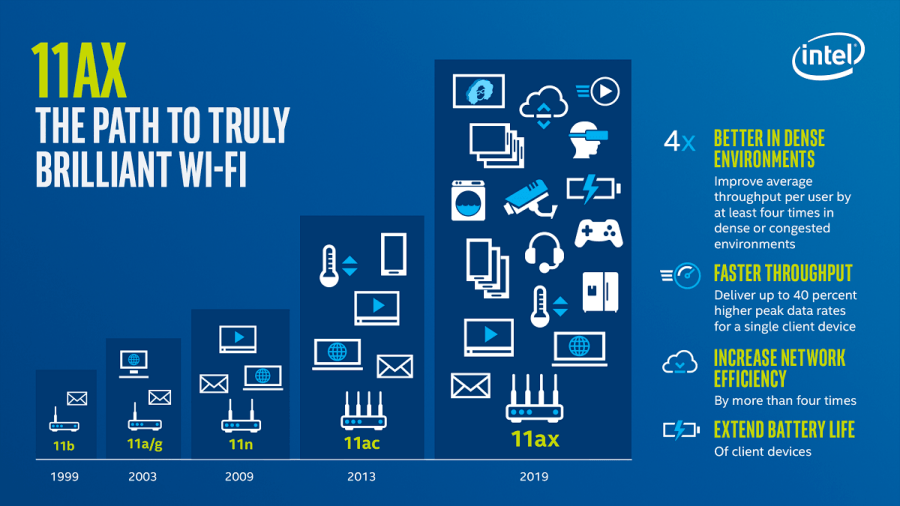
Wi-Fi 6 is faster because it encodes data more efficiently, resulting in much higher performance. More data is squeezed into the same radio waves. The chips that encode and decode these signals continue to get more powerful, so they can handle larger amounts of data.
The new standard boosts speeds even on 2.4GHz networks. While the industry prefers 5GHz Wi-Fi for less interference, 2.4GHz is still better at penetrating solid objects.
Longer battery life
A new “target wake time” (TWT) feature helps your Wi-Fi-enabled smartphones or computers get longer battery life.
When the router “talks” to a device (like your smartphone), it can tell the device exactly when to put the Wi-Fi to sleep and when to wake it up to receive the next transmission. This will save power on the devices, because the Wi-Fi will get more time in standby mode. This of course means longer battery life for your device.
Better performance in busy areas
Wi-Fi doesn't give a good signal when you're in a crowded place with lots of devices using it. Imagine a crowded stadium, an airport, a hotel, a shopping mall. Maybe your connection is too slow.
The new Wi-Fi 6, also known as 802.11ax, will bring a number of new technologies to help with this problem. Intel says Wi-Fi 6 will improve average speeds per user by “at least four times” in congested areas.
This is not only true for busy public spaces, but also for your home if you have multiple devices connected to Wi-Fi.
Why Wi-Fi 6 is better at congestion
While you don't need to know the details, a Wi-Fi 6 hotspot with a Wi-Fi 6 device will work better. Let's see why:
Wi-Fi 6 can divide a wireless channel into many subchannels. Each of these subchannels can carry data intended for a different device. This is because of Orthogonal Frequency Division Multiple Access, or OFDMA, technology. The Wi-Fi hotspot can “talk” to more devices at the same time.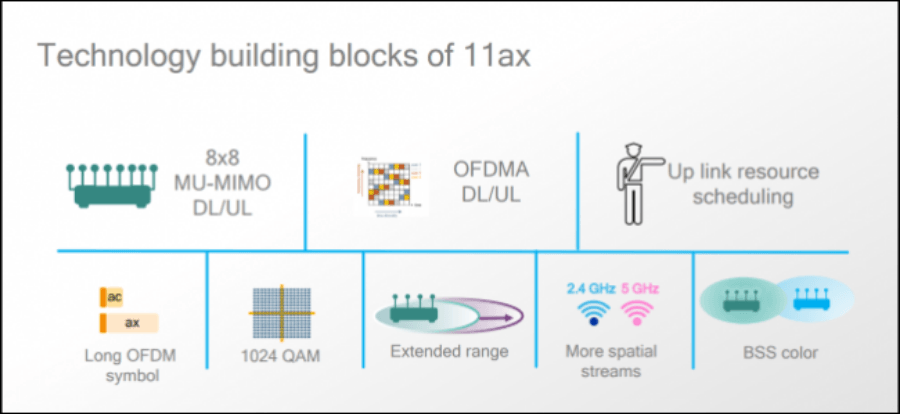
The new riderless has improved MIMO—Multiple In/Multiple Out—which allows the hotspot to “talk” to many devices at once. With Wi-Fi 5, the hotspot could “talk” to devices at the same time, but those devices couldn’t respond at the same time. Wi-Fi 6 has an improved version of multi-user, or MU-MIMO, that allows devices to respond at the same time.
Multiple hotspots in close proximity may be broadcasting on the same channel. In this case, the router listens and waits for a clear signal before responding. With Wi-Fi 6, wireless access points in close proximity can be configured to have different Basic Service Set, or BSS, colors. This “color” is simply a number between 0 and 7. So if a device is checking to see if there are clear channels to listen to, it might notice a transmission with a weak signal and a different “color.” It will then ignore that signal without waiting, improving performance in congested areas.
Look for “Wi-Fi 6” and “Wi-Fi 6 Certified”
If you want to buy a new device, you won’t need to read the entire manual. The device manufacturer will list it as “Wi-Fi 6” or “Wi-Fi 5.”
You'll also start seeing the "Wi-Fi 6 Certified" logo on devices that have passed the Wi-Fi Alliance certification process. Previously, there was a "Certified Wi-Fi" logo that didn't mention the product generation.
These Wi-Fi 6 routers should also support WPA3 for more secure connections to Wi-Fi networks, but WPA3 support is not required.
When will you get it?
ASUS has announced the RT-AX88U router. It features some 802.11ax technologies but doesn't support the final standard, which is not yet finalized.
Some routers may already be advertising “802.11ax technology,” but Wi-Fi 6 hasn’t been finalized yet. There are also no devices available that support Wi-Fi 6 yet.
The Wi-Fi Alliance expects the standard to be finalized and released sometime in 2019. So after 2019 we will see new routers, smartphones, tablets, and laptops with the new technology.
_____________________
- Windows: the disk is constantly working
- Network latency : The 8 best tools for measuring network latency
- Google Assistant: multilingual speech recognition now available
- Which browser do you trust the most?
