

Windows Defender, according to Microsoft, has improved a lot in recent builds of Windows. Of course, independent tests show the software always in the bottom positions. But Microsoft continues to praise it tirelessly. Today, the company published an in-depth analysis that details how its super software can block completely unknown malware.
Microsoft says that Windows Defender only takes 10 seconds (at most) to analyze a file infected with malware, even if it has never been released before. Microsoft's antivirus will not only protect that user, but will submit the infected sample to protect everyone who uses Windows Defender.
The company emphasizes that the Cloud is what makes Windows Defender react so quickly and effectively in the case of unknown malware, explaining that while it inspects files for potential infections, it also prevents potential malicious behavior on the systems of all Cloud users.
As described in the infographic below, when suspicious files are detected, they are submitted to the cloud for in-depth analysis. Once the cloud determines that the file is unknown, it requests a sample for further analysis. 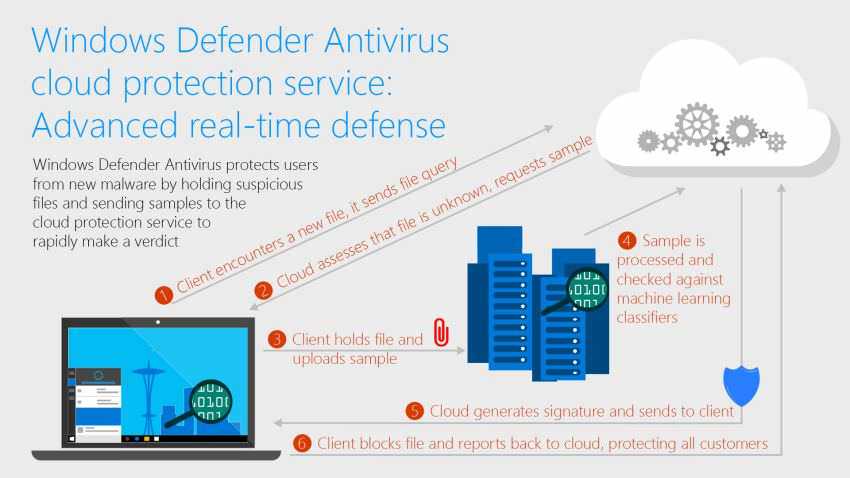
The file is automatically uploaded to Microsoft's cloud systems, which process it using machine learning.
The Cloud then creates a signature and sends it to the client, while the Windows 10 system blocks the file and from the cloud begins to protect all other users of the operating system.
The entire process is completed in less than 10 seconds, and according to Microsoft, it offers full protection once cloud analysis is enabled from the “Settings” app.
“When enabled, Windows Defender AV locks suspicious files for 10 seconds by default while querying the Windows Defender Cloud AV protection service. Administrators can configure Windows Defender AV to extend the timeout period by up to one minute to give the cloud time to further analyze and apply additional techniques to detect new malware,” Microsoft says.
This feature is only available in the latest version of Windows 10 Creators Update, which will be released in September.
