

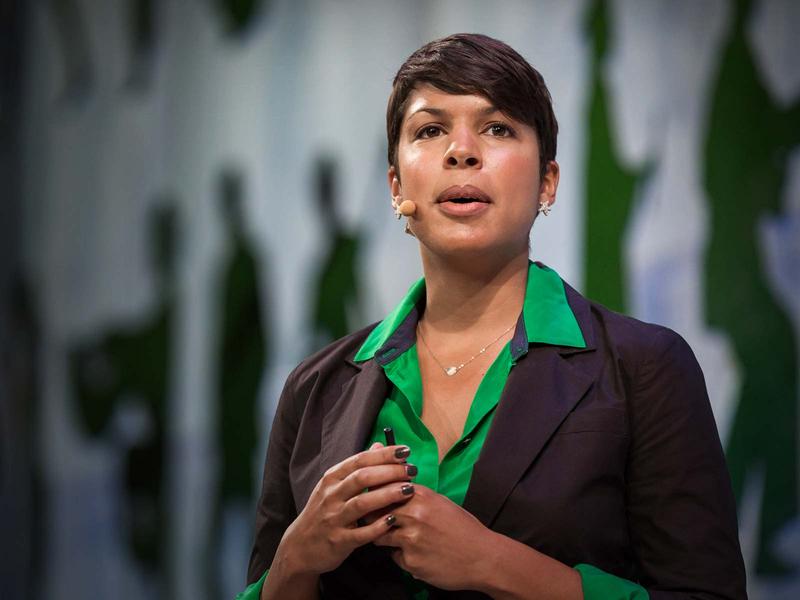
Hacking is more about mischief or political subversion. In this inspiring TED, Catherine Bracy describes how it can be a force for good or evil. She takes us through some inspiring urban projects in Honolulu, Oakland, and Mexico City—and makes a compelling case that we all have what it takes to get involved.
The video subtitles
0:11 I'm going to talk about hackers. The image that comes to mind when I say that word probably isn't Benjamin Franklin, but I'll explain why it should be.
0:22 The image that comes to mind is more of a sickly kid sitting in the basement making mischief, or a shady criminal trying to steal your identity, or an international fraudster with political agendas. The mainstream culture has somehow fed this idea that hackers are people to be feared.
0:48 But like most things in technology and the tech world, hacking can do both good and bad. For every hacker trying to steal your identity, there's one building a tool that will help you find your loved ones after a disaster or monitor environmental quality after an oil spill. In reality, hacking is just any amateur innovation in an existing system, and it's a deeply democratic activity. It's about critical thinking. It's about questioning the existing ways of doing things. It's the idea that if you see a problem, you work to fix it and not just complain about it. And in many ways, hacking is what created America. Betsy Ross was a hacker. The Underground Railroad was a great hack. From the Wright Brothers to Steve Jobs, hacking has always been at the foundation of American democracy.
1:43 So, if there's one thing I want you to remember today, it's that the next time you think of a hacker, you won't think of this guy, you'll think of this guy, Benjamin Franklin, who was one of the greatest hackers of all time. He was one of America's most prolific inventors, even though he never filed a patent, because he believed that all human knowledge should be freely available. He brought us bifocals and the lightning rod, and of course he was also instrumental in inventing American democracy.
2:17 And in Code for America, we're really trying to embody the spirit of Ben Franklin. He was a craftsman and a statesman whose concept of citizenship was always based on action. He believed that government could be built by the people, and we call those people civic hackers.
2:37 So it's not surprising that the values that underlie a healthy democracy, like cooperation, empowerment, participation, and enterprise, are the same values that underlie the Internet. And it's not surprising that many hackers are turning their attention to the problem of government.
2:56 But before I give you some examples of what civic hacking looks like, I want to make it clear that you don't have to be a programmer to be a civic hacker. You just have to believe that you can bring a 21st-century toolkit to the problems that this government has. And we hear all the time from our community of civic hackers at Code for America that they didn't realize how much, really, non-technical work there was in civic hacking projects. So don't forget that. You are all potential civic hackers.
3:25 So what does civic hacking look like? Last year, our team in Honolulu, who in this case were three full-time interns doing a year of public service, were asked by the city to rebuild the website. This is a huge project with tens of thousands of pages that simply wouldn't be possible in the few months they had. So instead, they decided to build a parallel website that was better suited to how citizens want to interact with information on a government website. They're looking for answers to questions, and they want to take action when they're done, which is very difficult from a website that looks like this. So our team built "Honolulu Answers," which is a simplified interactive search where you enter a search term or a question and you get answers in plain language that lead a user to action. The page itself was pretty easy to set up, but the team faced the challenge of how to fill in all the content. It would have taken the three of them a very long time to work on it, especially since none of them were from Honolulu. And they did something really radical, if you think about how government usually works. They asked citizens to write the content. You've heard of the hackathon series. They did a series of writing events. where in the course of a Saturday afternoon -- ("What do I do when wild boars get annoying?") (Laughter) -- Apparently, wild boars are a big problem in Honolulu. In the course of a Saturday afternoon, they were able to fill in most of the content for the most popular questions, but more importantly, they created a new way for citizens to participate in their government.
5:00 I think that's a really great story in itself, but it gets even more awesome. On National Urban Hacking Day last June in Oakland, where I live, the Code for America team in Oakland took the open source base of "Honolulu Answers" and made it "Oakland Answers," and again we set up a series of writing events where we took the most popular questions and had citizens write their answers, and I participated. I wrote that answer and a few others. I still try to articulate today the sense of empowerment and responsibility that I feel for the place where I live based on just that small act of participation. And, by putting my small act together with the thousands of other small participatory acts, made possible through civic hacking, we believe we can reactivate citizenship and restore trust in government.
5:58 At this point, you might be wondering what city officials think about all this. In fact, they love it. As most of you know, cities are challenged to do more with less every day, and they're always looking for innovative solutions to real-world problems. So when you give citizens a way to participate beyond just attending a town hall meeting, cities can realize the potential in their communities to do the work of government.
6:25 I don't want to give the impression that urban hacking is just an American phenomenon. It happens all over the world, and one of my favorite examples is from Mexico City, where earlier this year, the Mexican House of Representatives contracted with a software development company to build an app that lawmakers would use to track bills. This was just for the few lawmakers in the House. And the contract was a two-year contract for $9.3 million. A lot of people got really angry about that, especially computer geeks who knew that $9.3 million was an absolutely outrageous amount of money for such a simple app. But instead of taking to the streets, they issued a challenge. They asked developers in Mexico to come up with something better and cheaper, and they offered a prize of $9,300 — 10,000 times cheaper than the government contract, and they gave participants 10 days. And within those 10 days, 173 apps were submitted, five of which were presented to Congress and are still in the app market today. And because of that action, that contract was canceled, and now that has sparked a movement in Mexico City, which is home to one of our partners, Code for Mexico City.
7:49 So what you see in all three of these places, in Honolulu, in Oakland, and in Mexico City, are the elements that are at the core of urban hacking. Citizens who saw things that could work better decided to fix them, and through that work, they're creating a 21st-century ecosystem of participation. They're creating a whole new set of ways for citizens to engage, beyond voting or signing a petition or protesting. They can actually build governance.
8:20 So, back to our friend, Ben Franklin, one of whose lesser-known achievements was founding, in 1736, the first volunteer fire company in Philadelphia, called a brigade. And this was because he and his friends noticed that the city was struggling to cope with all the fires that were happening in the city, so, with some real urban hacking, they came up with a solution.
8:46 We have our own brigades at Code for America that are working on projects that I just described, and we want to ask you to follow in Ben Franklin's footsteps and join us. We have 31 brigades in the United States. Today we are pleased to announce that we are opening the brigade to global cities for the first time, starting with cities in Poland, Japan, and Ireland. You can find out if there is a brigade where you live at brigade.codeforamerica.org, and if there is not a brigade where you live, we will help you. We have created a set of tools that are also available at brigade.codeforamerica.org, and we will support you along the way. Our goal is to create a global network of urban hackers who innovate on the existing system to build tools that will solve enduring problems, that will support local government, and that will empower citizens.
9:37 So come hack with us.
9:40 Thank you.
9:41 (Applause)
