

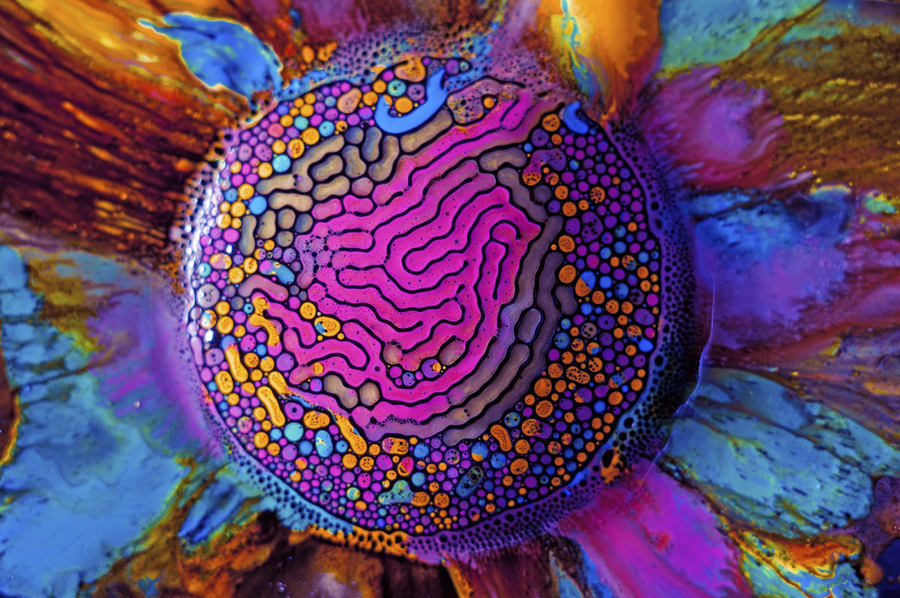
Swiss artist and photographer Fabian Oefner is on a mission. To make stunning works of art out of everyday science. In the charming talk below (from TED Talks), he presents some recent psychedelic creations, from photographs of crystals interacting with sound waves. In a live demo, you'll see what can happen when you mix paint with magnetic fluid or set fire to whiskey.
Translated by Chryssa Rapessi
Edited by Aphrodite Constantinou
A picture is worth a thousand words, so I'm going to start my talk by stopping and showing you some pictures that I took recently. So, now, my talk is already 6,000 words long, and I think I should stop here. (Laughter) At the same time, I probably owe you an explanation for the pictures that you just saw. What I try to do as a photographer, as an artist, is to bridge the worlds of art and science. Whether it's the image of a soap bubble that I photographed as it was popping, as you can see in this photo, or whether it's a universe of tiny beads of oil paint, strange liquids that behave in strange ways, or paint that is shaped by centrifugal forces, I'm always trying to connect those two fields. What I find very interesting about these two is that they're both looking at the same thing: It's a reaction to its environment. And yet, they do it in a very different way. If you look at science on the one hand, science is a very logical approach to its environment, whereas art on the other hand is an emotional approach to its environment. What I'm trying to do is bring those two perspectives together so that my images speak to the heart of the viewer as well as to their brain. Let me give you a demonstration based on three works. The first one has to do with the visualization of sound. Now, as you may know, sound travels in waves, so if you have a speaker, the speaker does nothing more than take the sound signal, turn it into a vibration, which then travels through the air, is picked up by our ear, and is turned back into a sound signal. Now I was thinking, how can I make these sounds visible? So I made the following scene. I took a speaker, I put a thin film of plastic on top of that speaker, and then I added tiny crystals on top of the speaker. And now, if I play a sound through that speaker, it's going to make the crystals move up and down. This happens very quickly, in the blink of an eye, so together with LG, we captured this movement with a camera that can capture over 3,000 frames per second. Let me show you what it looks like. (Music: "Teardrop" by Massive Attack) (Applause) Thank you very much. I agree, it looks amazing. But I have to tell you a funny story. I got burned indoors when I was doing a photo shoot in Los Angeles. In Los Angeles you can get a good sunburn on any of the beaches, but I got mine inside and what happened, when you're shooting at 3,000 frames per second, you need incredible light, a lot of light. So we set up this speaker and we had the camera looking at it and a lot of light aimed at the speaker and I set up the speaker and I put these tiny crystals on this speaker and we did it over and over and it was noon before I realized that my face had turned bright red because of the light that was aimed at the speaker. The funny thing is that the speaker was only on the right side, so the right side of my face was bright red and I looked like the Phantom of the Opera for the rest of the week. Let's move on to another project that has to do with less harmful substances. Have you heard of iron hydroxide? Oh, some of you know it. Great. Should I skip this part? (Laughter) Iron hydroxide has a very strange behavior. It's a liquid that's completely black. It's oily. And it has tiny metal particles in it that make it magnetic. So if I put this liquid in a magnetic field, it's going to change its appearance. I have a live demonstration here to show you. I have a camera looking at this plate, and under this plate I have a magnet. Now I'm going to add some iron hydroxide to this magnet. Let's move it a little bit to the right and maybe focus it a little bit more. Great. What you see is iron hydroxide that has formed spikes. This is due to the attraction and repulsion of the individual particles in the liquid. Now it already looks pretty interesting, but let me add a little watercolor to it. These are just regular watercolors that you would paint with. You wouldn't paint with syringes, but it works the same way. Now what happened, when the watercolors ran through the structure, the watercolors didn't mix with the iron hydroxide. And that happened because iron hydroxide is hydrophobic. That means it doesn't mix with water. And at the same time, it tries to hold its position above the magnet, and so it creates these amazing structures of channels and tiny pools of colored watercolors. That was the second project. Now I'm going to go to the last project, which is about the national drink of Scotland. (Laughter) These pictures were taken using whiskey. You might be wondering, how did he do that? He drank half a bottle of whiskey and then painted his drunken hallucinations on paper? I can assure you that I was fully aware when I took these pictures. Now, whiskey is 40 percent alcohol, and alcohol has some very interesting properties. You may have experienced some of these properties, but we're talking about the physical properties, not the others. So when I open the bottle, the alcohol molecules spread out into the air, and that's because alcohol is a very volatile substance. At the same time, alcohol is highly flammable. And with those two properties, I was able to create the images that you're seeing right now. Let me do a demonstration here. What we have here is an empty glass container. It has nothing in it. And I'm going to fill it with oxygen and whiskey. Just a little bit more. Now we just wait a little bit and the molecules spread out into the bottle. And now, let's set it on fire. (Laughter) That's it. It's very fast and it's not that impressive. I could do it again so you can see it again, but some people would say that it's a waste of whiskey and that I'd be better off drinking it. But let me show you in slow motion in a completely dark room what I just showed you in this live demonstration. What happened was that the flame traveled through the glass container from the top to the bottom, burning the mixture of air and alcohol molecules. So the images that you saw at the beginning, is actually a flame frozen in time as it travels through the bottle, and you have to imagine that it's turned 180 degrees. That's how these images were created. (Applause) Thank you. So, I've shown you three works, and you might be wondering, what's the point of them? What's the idea that inspired them? Did we just spoil the whiskey? Is it just some weird stuff? These three works are based on very simple scientific phenomena, like magnetism, sound waves, or here, the physical properties of a substance, and what I'm trying to do is use these phenomena and present them in a poetic way that we've never seen before and thus invite the viewer to stop for a moment and think about all the beauty that surrounds us all the time. Thank you very much. (Applause)
