

Researchers have officially confirmed a suspicion we've all had: Parents and kids speak different languages online. And not just online, of course, but this particular study, conducted by PLoS ONE, looked only at online language. The results of the largest study to date attempt to connect personality and language. The findings offer an unprecedented look at how differences in age, gender, and temperament affect the way we communicate on social media.
The study used more than 15 million messages sent to 75,000 Facebook users. Through these messages, researchers at the University of Pennsylvania were able to discover which words, phrases and topics are most associated with certain personalities and their demographics.
(Below, along with the Greek word, we will also list the corresponding English word.)
Women use the word “excited” more often, the study found. Men use the word “f*ck” more often. Ages 19 to 22 discuss their “drunkenness” while ages 23 to 29 choose the expression “We drink beers.”
The available data that exist on Facebook allowed researchers to have an “open vocabulary” in their approach to analysis: Instead of comparing the frequency with which different groups used a predefined set of words, they could instead have the significant words and phrases from the sample itself.

What would you say at each age?
On Facebook, teen language is dominated by emoticons, references to school, and interjections like “ugh” and “bleh.” By the age of 20, conversations are about degrees and graduate school, semesters, and the word “sh*t.” By the mid-20s, conversations about marriage, time off, and work begin. For people between the ages of 30 and 65, family dominates conversations, reports the Huffington Post. (See the word cloud by age.)
An additional proof of the maturity of age is seen from the use of the “I” generation and the “we”. The older ones in their discussions can talk about their fears while the younger seem to have a more narcissistic disposition:
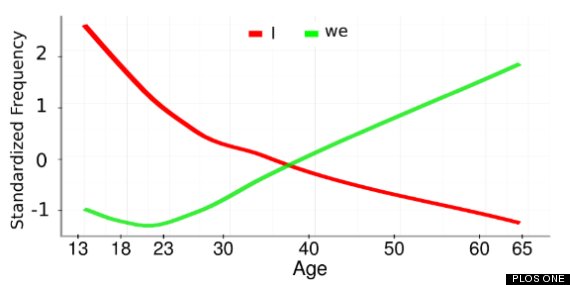
Complaints also appear to decrease with age. As people get older, Facebook posts contain fewer complaints and also talk about “love”, “care”, “integrity” “family” and “friendship”.
Different personality types tend toward different words and topics, the research found. Extroverts were more likely to discuss topics about relaxation or political parties, while introverts, in turn, focus more on topics involving solitary activities, such as their computer. The researchers also highlighted a link that individuals with emotional stability tend to discuss their social activities, such as sports and vacations.
The researchers reported that the results of the study offer a glimpse into the world through the eyes of others.
“When I ask, “what is an extrovert like?” “What characteristics does a teenage girl have?” “How is a schizophrenic or a neurotic?” or “What is it like to be 70 years old?” the word clouds can also get much closer to the heart of the subject than all the questionnaires that exist to date, said Martin Seligman from the Center for Positive Psychology at the University of Pennsylvania.
Andrew Schwartz, one of the study's authors, said their findings highlight not only the topics that are most discussed between the average man or woman, but also the expressions that differentiate them.
The researchers were able to predict a person's gender from their expressions with 91.9 percent accuracy.
