

About a month ago, Naked Security readers took part in a poll conducted by the website. The question was “Which browser do you trust?” Their answer was unequivocal: Firefox .
This question came after the revelations of the NSA and we mention it because it is possible that if the same question had been asked before the scandal, the results might have been different. However, reliability is always an important criterion for choosing web browsers and there is no objective criterion for this.

Modern web browsers are all quite mature and complex products. Choosing the right web browser is now a matter of many parameters. Of course, the first things we consider are speed, security and respect for our privacy.
The poll asked the six most popular web browsers – Chrome, Firefox, Internet Explorer, Opera, Safari and Chromium – for answers.
Mozilla 's Firefox , the linear descendant of Netscape Navigator and the original NCSA Mosaic graphical Web browser , was the big winner.
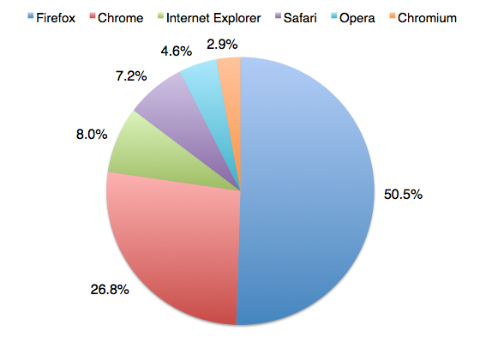
Firefox won almost twice as many votes as its closest competitor, Google Chrome , and more votes than its eternal rival and veteran Internet Explorer .
See the results.
Firefox 50.5%
Chrome 26.8%
Internet Explorer 8.0%
Safari 7.2%
Opera 4.6%
Chromium 2.9%
Internet Explorer's poor performance is notable, but perhaps not surprising given Microsoft's past mistakes and the NSA's history.
What stands out is the difference between Mozilla and Chrome. Both browsers are established and well-known open source projects, and both run on Windows, Mac, and Linux, unlike Explorer or Safari.
Maybe Chrome users are more realistic about what they trust, or maybe they are people who don't vote in online polls. But let's not forget the NSA. Google's security claims may no longer be convincing.
