

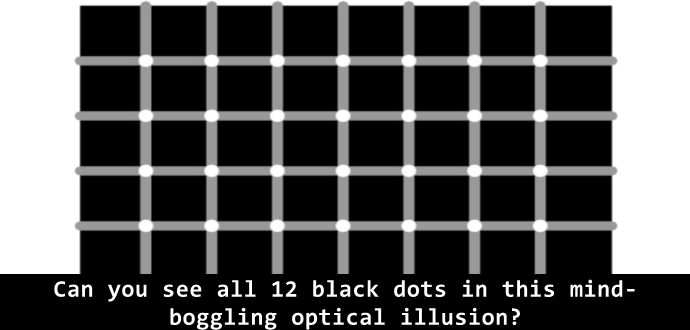
A new optical illusion has taken the internet by storm.
Twelve black dots are the focus of this optical illusion, as people can't figure out why they can't see all the dots at once! Will Kerslake, a game developer, posted a confusing image of intersecting gray lines on a white background to Twitter on Sunday. The image was retweeted over 30,000 times as people tried to figure out how it worked.
The optical illusion has been in the news in recent days after it was posted on Facebook this weekend by Japanese psychology professor Akiyoshi Kitaoka. However, the origin of this unexplained image is a scientific study published in the journal Perception in 2000. In the image, there are actually twelve dots at each intersection. However, your brain won’t let you see them all at once. As a result, every time your eyes move, one dot disappears and another appears. “They think it’s an existential crisis,” says Derek Arnold, a vision scientist at the University of Queensland in Australia. “How can I ever know what the truth is?” But, he adds, scientists who study the visual system know that perception doesn’t always equal reality. French scientist Jacques Ninio said the illusion has to do with people’s poor peripheral vision. “When white dots in an intelligent network are reduced in size and have a black outline, they tend to disappear. We only see a few of them at a time, in groups that move erratically across the page,” explained Mr. Ninio. “When we don’t see them, the gray alleys appear to be continuous, creating gray intersections that don’t really exist. “Some black shapes can be seen at these intersections. The illusion also works in reverse.”
So when you focus on a single black dot in the center of your visual field, your brain plots out what it thinks is most likely happening around it. And, it assumes that there will just be gray lines on the white background, missing the black dots, which is why there are no black dots.
