

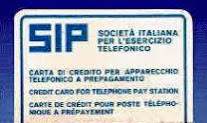
The telephone cards were invented in the autumn of 1975 in Italy by SIDA. The company, SIDA, was not in the telecommunications sector; it was a manufacturer and supplier of vending machines, and it collaborated with the telecommunications company SIP for further use of the card.
The first prepaid telephone card operated in early 1976 with the main goal of combating vandalism of public phones, and the new payphones were installed in the Villa Borghese district of Rome.
The early cards worked by reading a magnetic stripe on the back for use in special payphones, they were very thin and cost 50 Italian lira. The first countries to follow Italy in the use of telephone cards were Austria, Sweden, France, and the United Kingdom
In 1984 the first chip on a telecard was released in France. In 1988 the first telecard catalog for collectors was published by Dr. Steve Hiscocks, in England.
OTE could not stay behind the developments, but we had to wait until 1992 to see the first Greek telecard, which was released in 30,000 copies and depicted the sixteen-pointed star of Vergina, and which today has collectible value.
From 1992 to the present day, OTE has put into circulation more than 2,500 phone cards, which have acquired a second dimension, the collectible one, after the useful one.
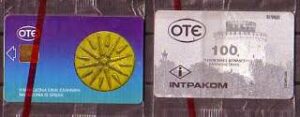
The collectible value of a phone card is determined by a series of parameters, the most important of which is the number of copies in which it has been issued. That is, the fewer copies it has been issued, the greater its value. Another element is any typographical, spelling or other errors that occurred during the production of the phone card. Those in the know in the field hunt these errors with a passion, which can sometimes prove to be particularly profitable for them. Another golden rule of collectors is that full phone cards are worth more than used ones (a fairy tale to get rid of their mistakes by merchants)
Regarding the “stock market” of the telecard, the prices are determined by the old but proven rule of supply and demand.
OTE, on the occasion of converting the telecard into a collectible item, created a few years ago a Telecard Collectors Service Office. Through this office, collectors can obtain the entire set of telecards circulating in the Greek territory. Additionally, the subscribers of this Office have the exclusive privilege of acquiring the collectible cards issued each year by OTE and which are not available on the market. Today, more than 5,000 collectors are subscribers of the Collectors Office, and it is estimated that nationwide the number of collectors exceeds 25,000.

Besides the OTE Telecard Collectors Service Office, there are also several gatherings of collectors where telecard buying and selling take place in Athens, Monastiraki, and in Thessaloniki at the intersection of Karolou Dtil and Ermou streets (near OTE) and at Bit Bazaar (Tositsa street).
In general, the OTE Card Collector Service Office never operated according to collection rules; it was and remains a bureaucratically shackled service without substantive results, it also charges a separate fee for each registered collector, an unimaginable fact on a global level.
The collection of telecards has been in a state of inertia, very few still engage in collecting and studying telecards, and most simply gather whatever they can without knowledge.
Prices today have plummeted to unbelievably low levels, the only exceptions are the first collectible editions and the bugs (many of which served as bait to attract collectors with the blessings of the manufacturing companies and OTE).
Source: tro-ma-ktiko.blogspot.gr
