

In fact, it's one of the most widespread myths in the tech world. At the same time, it's not entirely certain that it's true. This double-sidedness of the coin is probably why the myth is so enduring. In the early days of computers, scary stories about viruses and hardware were spread by users. In these stories, viruses were implicated in some "error" in a CRT monitor and "burned" parts of the computer's hardware. In other stories, malware would create sounds on HDD hard drives and eventually destroy them or overclock a floppy disk and cause an imminent fatal overheating of the rotor.
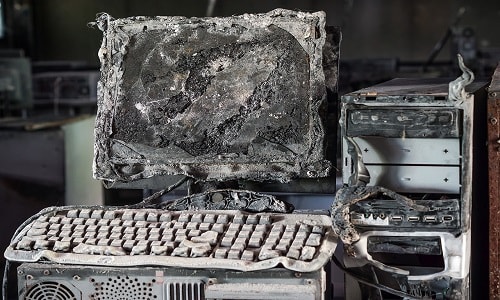
Antivirus developers are constantly debunking these myths. Sure, some of these cases are theoretically plausible, but the built-in foolproof protection mechanisms don't allow such omissions to happen.
However, life is a strange thing and full of surprises. For example, in 1999 a massive virus Win95.cih (also known as Chernobyl) infected thousands of machines. This malware corrupted data stored on hard drives as well as BIOS chips on motherboards. Some of the infected computers wouldn't boot because their bootloader had been corrupted. To restore the machine to its original state, one had to replace the BIOS chips and rewrite the data.
Was it essentially a physical damage inflicted on a PC? Actually, no. After a series of manipulations, motherboards could be cured and returned to their original working state, but the problem required special equipment.
Today, everything is even more incomprehensible.
First of all, each autonomous piece of hardware is combined with a rewritable firmware, sometimes even more than one.
Each of these firmware has evolved over the years, becoming a fairly complex piece of software, which is by design open to attacks. However, if the attack is successful, the consequences are not always immediately treatable.
Take, for example, the modified firmware of hard drives. Kaspersky Lab specialists, while analyzing the Equation cyberespionage campaign, discovered spyware modules embedded with firmware code for a number of different HDD models. These pieces of malware are used to gain complete control over the infected drive, a problem that cannot be solved by simply formatting it. No one can change the firmware through a standard toolkit – the firmware updates itself.
Can this be considered physical damage? Well, that is debatable. But the number of stories about hardware-based vulnerabilities continues to grow.
Second, it is quite unclear what kind of machine can be defined as a “computer”. For example, a modern car is, to some extent, a computer – and more importantly – a connected computer on wheels. It is vulnerable to remote hacking, as we saw in the recent demonstration of remote hacking of a Jeep Cherokee.
Ultimately, can a virus really damage computer hardware? Is it fact or myth?
Is it true. However, the answer also depends largely on what the terms “damage”, “virus”, “PC” and so on actually mean.
