He created the first antivirus for computers, made millions, lost almost everything, fled to his private tropical island, was suspected of manufacturing drugs, was accused of murder, lived as a fugitive and today he attacks Google, saying that it invades our lives
Idealist or opportunist? Defender of the right to protect our personal data or criminal? Devilishly smart or schizophrenic? John McAfee, creator of the first antivirus program for computers - back in the mid-1980s - is a dark figure. He became very rich by looking into the digital future, which, however, held in store a myriad of adventures and entanglements.
“You can’t have people invading our lives and still have our freedom… My freedom is all I have. And that’s all you have, if you think about it,” John McAfee said recently in Las Vegas. Addressing a packed audience at Defcon, the world’s largest known gathering of hackers, the pioneer in protecting computer systems from malware attacks took aim at Google.
"Google wants us to believe that if we have nothing to hide, we shouldn't care if everyone knows everything about what we do. But if everyone knew everything about everyone, what would happen to human behavior? That's something we need to think about carefully.".
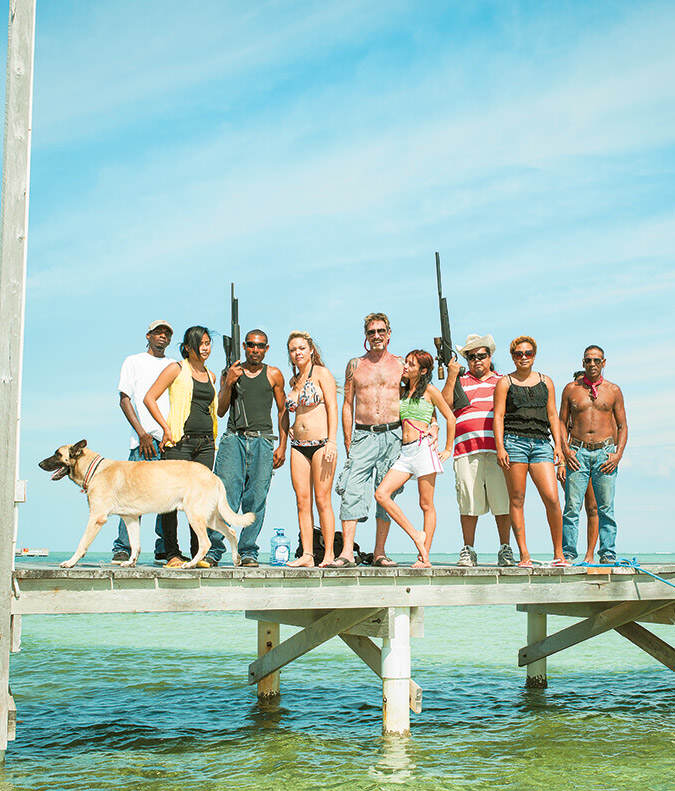 John McAfee in 2012 on the pier of his private island in the Caribbean
On the same day, the controversial John McAfee announced the establishment of the initiative “The Brown List”. Its aim is to coordinate the action of individuals in addressing major problems. How? By collecting online complaints from citizens about injustices that exist, such as the attempted repression by a government or the callous act of a large company. “Turn your anger into something positive,” he said in his speech in Las Vegas, apparently inspired by his personal experiences. He claimed that all his money was tied up in Belizean banks and that is how he is raising money from donations for his new venture.
Fort in the jungle
In the small Central American country on the northwestern coast of the Caribbean, McAfee, now 68, had set up his own fortress a few years ago. He lived under the protection of a small private army, mostly made up of ex-convicts. He was also surrounded by young Latinas, with whom he shared his bed.
When Joshua Davis of Wired magazine met him on his private tropical island, 24 kilometers off the coast of Belize, in the summer of 2012, he could not hide his surprise at what he saw happening there… John McAfee, thin, with his hair dyed blond in places and tattoos covering his arms and shoulders, greeted him holding a revolver. Having left a bullet in the Smith & Wesson grinder, he did not hesitate to play Russian roulette in front of the frightened reporter.
He put the gun to his head and pulled the trigger over and over again! In front of him, on the coffee table in the living room of the wooden house, there were ammunition, fake IDs with his photo, a powerful bear repellent spray and a baby pacifier… “I can do this all day long,” he had said, the sound of the click of the trigger like a hammer in Davis’s ears. “I can do this a thousand times, ten thousand times. Nothing will ever happen. Why? Because you’ve lost something. You’re operating with a hypothetical perception of reality that’s wrong…”.
So, after John McAfee had played with his visitor's stamina and mind, he referred to the then-recent raid by law enforcement authorities on his farmhouse.
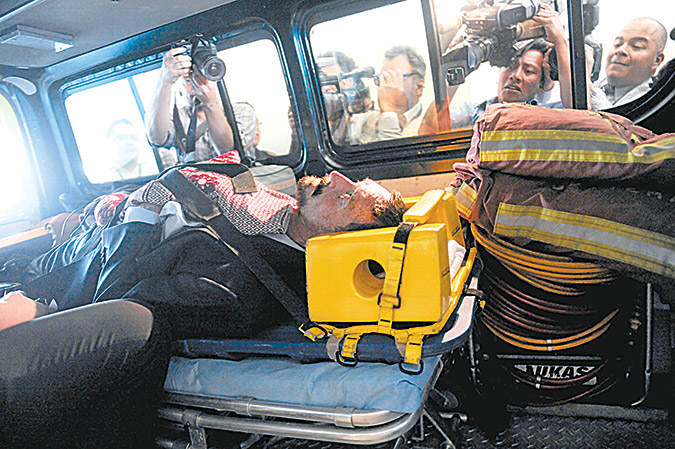 McAfee in an ambulance in Guatemala City, when he faked a heart attack to delay his extradition to Belize
The commando raid
It was the night of April 30, 2012, when the guard at the entrance gate was unaware of what was happening on the other side of the property. A specially trained FBI organized crime team had already invaded the area. Heavily armed, the commandos left no room for reaction for McAfee's guard. He, naked and with a revolver in his hand, was lying in the bedroom of the villa, which stood on stilts twenty feet above the damp ground. He looked nothing like the Silicon Valley tycoon he once was.
In 2009, he sold all his assets – including land and real estate in Hawaii, Colorado, New Mexico and Texas, as well as his private jet – and moved to the Caribbean. He announced that he would focus on creating natural antibiotics from ingredients found in rainforests. He had even built a laboratory for this purpose.
Now his stronghold was under attack and about thirty determined police commandos were closing in on him. As the Wired reporter describes in the article, he was terrified… He hugged the 17-year-old girl who was sleeping in his bed. As the commandos stormed the house, he put on a pair of shorts and, with his hands up, walked out into the hallway. The officers pushed him against the wall and handcuffed him. “You are under arrest on suspicion of producing methamphetamine,” one of the officers shouted at him. “This is an amazing case, sir,” McAfee replied. “And that’s because I haven’t sold drugs since 1983…” – he has admitted to using cocaine for many years, which he also “pushed” to colleagues. He was also an alcoholic, since his time in college, in the late 1960s, finding refuge years later in Alcoholics Anonymous meetings.
In Belizean prisons
The police ransacked the villa and the other bungalows, where his young mistresses usually stayed. They found several weapons and ammunition, as well as hundreds of bottles of chemicals, which they could not identify. During the investigation, they shot and killed one of his dogs when it became wild. Finally, after dawn, they took him, along with a fugitive from his personal guard, to the detention center of the capital's central police station. John McAfee was held there for less than 24 hours. He was ultimately not charged with any serious charges. No illegal substances were found in his laboratory. He was charged only with illegal possession of weapons and was released the next morning.
He lived under the protection of a small private army and was surrounded by young Latinas, with whom he shared his bed
McAfee had attracted the attention of law enforcement authorities when, two years after moving to Belize, he posted dozens of comments on the bluelight.ru forum, which deals with pharmaceutical and drug issues. He wrote that he was experimenting with a psychotropic stimulant found in bath salts. This is a class of substances that have similar effects to amphetamines and cocaine. “When I first accidentally got a few drops on my fingers from a used bottle, I didn’t sleep for four days. I had visual and auditory hallucinations and the worst paranoia of my life,” he wrote in one of his posts.
However, he later claimed that it was all just an elaborate hoax. "If I'm going to take drugs, I'm going to take something I know is good... Some mushrooms and maybe some high-quality cocaine. Anyone who knows me well, though, knows that I don't take drugs anymore," he said, playing on the nerves of his pursuers.
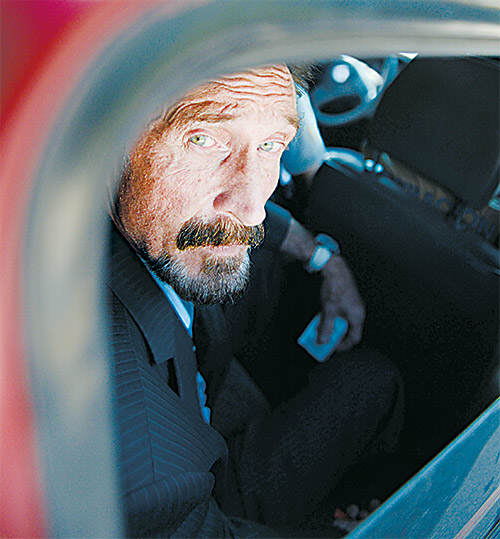
Fugitive in Guatemala
Finally, in mid-November 2012, John McAfee left Belize behind for good. He was now wanted for his possible involvement in a murder. Citing later his fear that the country's police were actually out to kill him, he justified his decision to flee when he learned that he would be questioned in the murder of Gregory Viad Fall, who had been found shot in the head in his home's swimming pool. He and Fall had argued a few times in the past..
When McAfee realized one afternoon that police were approaching his house again, he quickly dug a ditch in the sand and hid there, half-buried for hours, with a piece of cardboard over his head.
In December of that year, the now-fugitive McAfee was located in Guatemala after a journalist mistakenly published a photo of him with his location information. He had fled there after briefly staying at an expensive resort on Mexico's Yucatan Peninsula, relatively close to the border with Belize.
After his exposure in neighboring Guatemala, he requested political asylum. He was arrested for illegally entering the Central American country. A few days later, his request was rejected, so he was transferred to a detention center. There, as he later claimed, he twice feigned a heart attack in order to give his lawyer more time to file a series of appeals, preventing his extradition to Belize. Finally, on December 12, John McAfee was deported to the United States.
To date, Belizean authorities have not charged McAfee with any specific offenses. However, his assets in the Caribbean country were auctioned off and his home burned down under unclear circumstances.
The first electronic virus
The history of computer science says that in 1986, two brothers from Pakistan wrote the code for the first known computer virus. They didn't want to destroy anything. They did it out of curiosity, to see how far it would travel. To do this, they included their names, address, and the phone number of their business in Lahore. About a year later, their phone started ringing nonstop. Their virus, called "Brain," had infected computers all over the world.
John McAfee had already been clean from drugs and alcohol for four years and was working at Lockheed on a classified voice recognition project. He had worked on software development projects for NASA and Xerox since 1968, among other things. Reading an article in a San Jose newspaper about the spread of the Pakistani virus, he found the idea terrifying. It reminded him of his childhood when his father would beat him for no reason. He knew well what it was like to be the victim of an unprovoked attack. So he decided to do something. In 1987, he founded McAfee Associates in his home in Santa Clara and created the first digital threat response program, which he published in various databases of the time. He did not expect anyone to pay to get it.
His goal was to convince user communities to simply install it – mainly on business computers. Within the next five years, about half of the Fortune 100 companies were running McAfee’s antivirus, and they began paying for its license, bringing its creator several million dollars in revenue a year.
In October 1992, McAfee Associates went public on the Nasdaq, and its founder's shares were worth $80 million at one point. In 1994, John McAfee resigned from the company's management and two years later sold the last shares he had in his portfolio. In August 2009, the New York Times reported that the value of his personal fortune had shrunk from $100 million to $4 million as a result of the global financial crisis and his choice to invest mainly in real estate in previous years.
The company he founded, after a series of mergers, was acquired in 2010 by Intel, which has integrated the security software into its platforms.
McAfee in an ambulance in Guatemala City, when he faked a heart attack to delay his extradition to Belize
He lived under the protection of a small private army and was surrounded by young Latinas, with whom he shared his bed.
Source: protothema.gr