

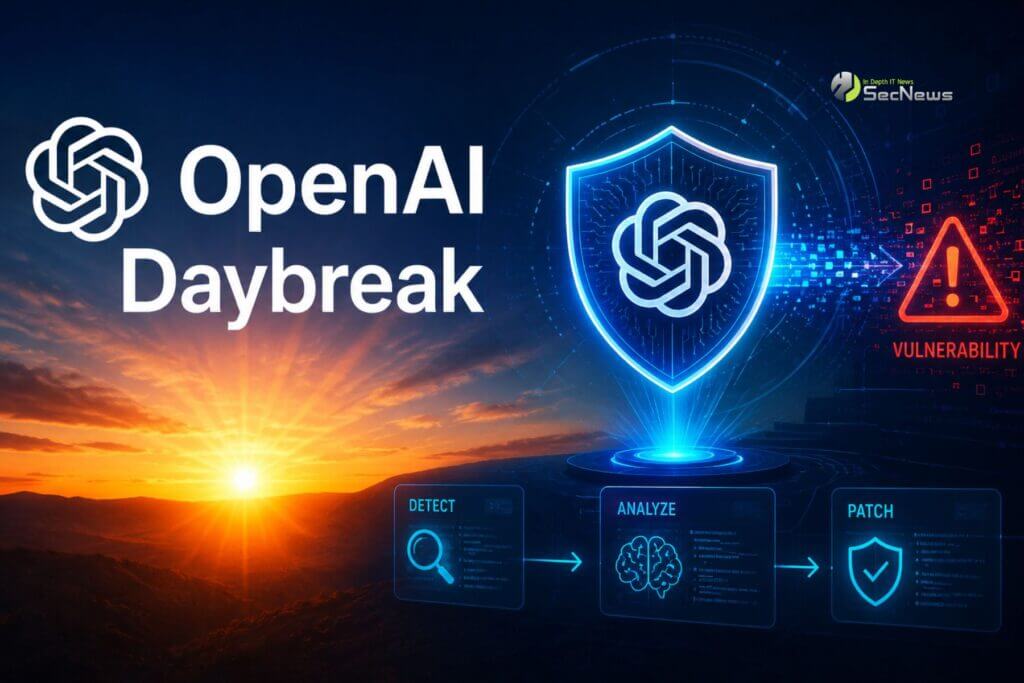
OpenAI has announced the launch of Daybreak , a groundbreaking artificial intelligence (AI) platform that aims to detect and fix security vulnerabilities before they fall into the hands of cybercriminals. The new service comes as a direct response to Anthropic ’s Claude Mythos , intensifying the competition in the AI-powered cybersecurity space and heralding a new era in proactive protection against cyberattacks .
Daybreak leverages the Codex Security AI agent, which was released in March, to create sophisticated threat models based on organizations’ code. The platform focuses on identifying potential attack paths, validating potential vulnerabilities, and automating the detection of high-risk vulnerabilities. According to OpenAI , the system can prevent attacks zero-day , giving organizations a critical time advantage that can help protect sensitive data. The technology uses advanced behavioral analysis to identify anomalies that would traditionally elude static security tools.
The release of Daybreak comes a little over a month after competitor Anthropic announced Claude Mythos . Claude Mythos was pitched as a security-focused AI model that the company deemed so risky (due to its capabilities) that it decided not to release it publicly. Instead, it shared it privately with select companies as part of its Project Glasswing initiative . However, unauthorized parties were able to gain access to the model, raising security concerns and highlighting the risks involved in developing such powerful cybersecurity tools. This incident highlights the importance of controlled distribution of such technologies.
Technical capabilities and innovations of OpenAI Daybreak
OpenAI has not had a similar security product until now, which has made it lag behind Anthropic in the cybersecurity field. Like Glasswing, Daybreak is not based on a single AI model but is a complete ecosystem. The company states that “Daybreak , combines the most capable models from OpenAICodex , and our security partners.” This multi-layered approach allows the platform to address different types of threats with specialized tools, from malware detection to social engineering attacks.
See also: Claude Mythos discovered 271 vulnerabilities in Firefox
The system incorporates specialized cybersecurity models, including GPT-5.5 with Trusted Access for Cyber and GPT-5.5-Cyber, which began rolling out last week. These models are specifically designed to address cybersecurity challenges, offering improved code analysis and threat detection. The new models have parameters that allow them to understand the details of exploit techniques and predict new attack methods.
OpenAI is working closely with “ industry and government partners ” as it prepares to “ develop increasingly capable cybersecurity models .” This approach suggests a strategic partnership with government agencies, as well as security companies , to create a comprehensive protection ecosystem. These partnerships include joint research, sharing threat intelligence, and developing common security standards that can be adopted globally.
See also: OpenClaw and Claude store AI-generated podcasts on Spotify

For maximum effectiveness, security experts recommend using Daybreak with tools SIEM and endpoint protection. The platform can act as a first line of defense, detecting code-level threats before they reach production systems. In addition, organizations should train their security teams on the use of Daybreak, as the platform’s effectiveness largely depends on the correct interpretation of results and the rapid implementation of recommended fixes.
See also: OpenAI GPT-5.4-Cyber: New AI model for cybersecurity
The emergence of Daybreak marks a new era in cybersecurity, where artificial intelligence is becoming the main weapon against cyberattacks. As threats become increasingly sophisticated, with hackers using artificial intelligence for their own attacks, the need for proactive security systems that can predict and respond to attacks before they happen is becoming critical for organizations worldwide.
🔒 Protect your privacy with Proton VPN
Swiss VPN from the creators of Proton Mail — strict no-logs policy, strong encryption, and built-in NetShield that blocks ads, trackers, & malware.
- ✔ No-logs, based in Switzerland (except 14-Eyes)
- ✔ NetShield: blocks ads, trackers & malicious domains
- ✔ Covers all devices — free version available
The link is an affiliate link — SecNews may receive a commission at no additional cost to you. It does not affect the independence of our article writing.
