

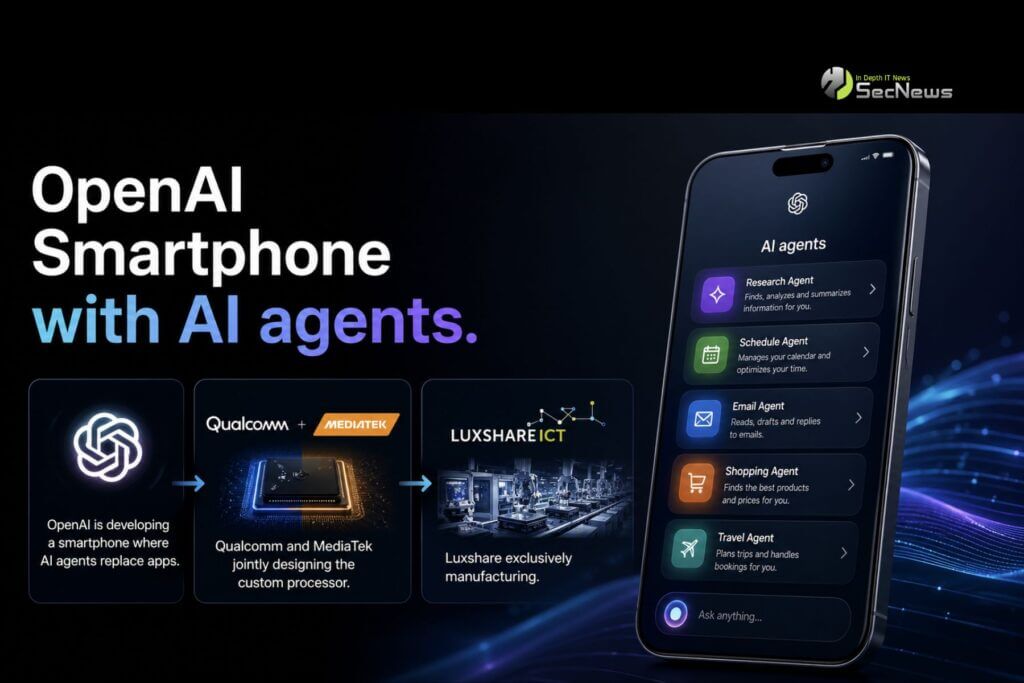
OpenAI appears to be considering a radically different future for smartphones , according to analyst Ming-Chi Kuo . The plan involves a device that will not rely on traditional applications , but on AI agents that directly take over the user's tasks. Giants such as Qualcomm and MediaTek are reportedly involved in the supply chain for processor design, while Luxshare Precision Industry is expected to take over the manufacturing of the device. Specifications and a list of suppliers are expected to be finalized by the end of 2026 or the first quarter of 2027, with the goal of mass production in 2028. If the analyst's predictions are confirmed, the device could reach up to 400 million shipments per year, a number that would put it on par with the iPhone and Samsung Galaxy.
The transition from applications to AI agents
The key differentiator of the device is not the hardware, but the interaction model. The phone Kuo describes is not a smartphone with an AI assistant. It is a device where the AI agent is the interface and the apps are obsolete. Instead of icons and apps, users will communicate with an “intelligent agent” that will carry out commands such as making restaurant reservations, composing messages or conducting research. This philosophy aligns with the vision outlined by Qualcomm CEO Cristiano Amonof a future where AI replaces the operating system as the primary interface. Most of the processing will be done hybridly: simple functions on the device and more complex ones in the cloud, creating a continuous, personalized user experience.
See also: OpenAI announces new, more efficient GPT-5.5 model
Parallel strategies and competition
OpenAI isn’t just limited to this device. It’s also working with Jony Ive to develop new categories of hardware, such as screenless devices. At the same time, companies like Apple and Samsung are investing in AI features inside existing smartphones, rather than completely reinventing the device. Apple is testing AI wearables, while Samsung is integrating multiple AI assistants into its devices, showing that the market has yet to settle on a single model.
The importance of the supply chain
One of the strongest elements of the forecast is the reliability of the partners. Qualcomm and MediaTek already dominate mobile processors, while Luxshare is a key partner of Apple. The next-generation chipsets support advanced AI capabilities, such as continuous data analysis and personalized learning. This means that the technological foundation is already there; the question is whether it can support such a different user experience on a mass scale.
See also: OpenAI Workspace Agents: New automation tools for businesses
Lessons from failed AI devices
The market has already seen failed attempts like the Humane AI Pin and the Rabbit R1. Both devices failed because they didn’t offer a sufficient reason for existence in relation to smartphones. In contrast, OpenAI’s venture aims to completely replace the smartphone, not supplement it. This strategy may prove more viable, but it comes with a higher risk.
The big bet on the market
Forecasts of hundreds of millions of sales remain extremely ambitious. For comparison, it took Apple and Samsung years to reach such volumes. OpenAI, with no experience in hardware production, will have to build infrastructure, distribution networks and customer support. At the same time, it will have to convince users to abandon an ecosystem of applications that they use every day.
See also: ChatGPT Images 2.0: New version of OpenAI's AI image generator
The future of smartphones is being redefined
The effort highlights a broader trend: the smartphone, as we’ve known it since 2007, may be approaching an inflection point. AI agents promise to simplify use and reduce the complexity of applications. But their success depends on whether they can deliver a faster, more reliable, and more intuitive experience. OpenAI is attempting to take the next big step, but the gap between an ambitious concept and a successful product remains enormous.
