

The James Webb Space Telescope (JWST) has achieved another technological milestone, giving astronomers the first direct look at the surface of a rocky exoplanet, a planet outside our solar system. The new discovery is considered crucial for the study of worlds beyond Earth's neighborhood, as until now most observations have been limited to analyzing atmospheres and not the actual geological composition of the planets.
At the center of the research is LHS 3844 b, a so-called "super-Earth" located about 50 light-years away. The planet is about 30% larger than Earth and is one of the most interesting targets for the scientific community due to its extremely close orbit around its parent star.
An extreme world without atmosphere
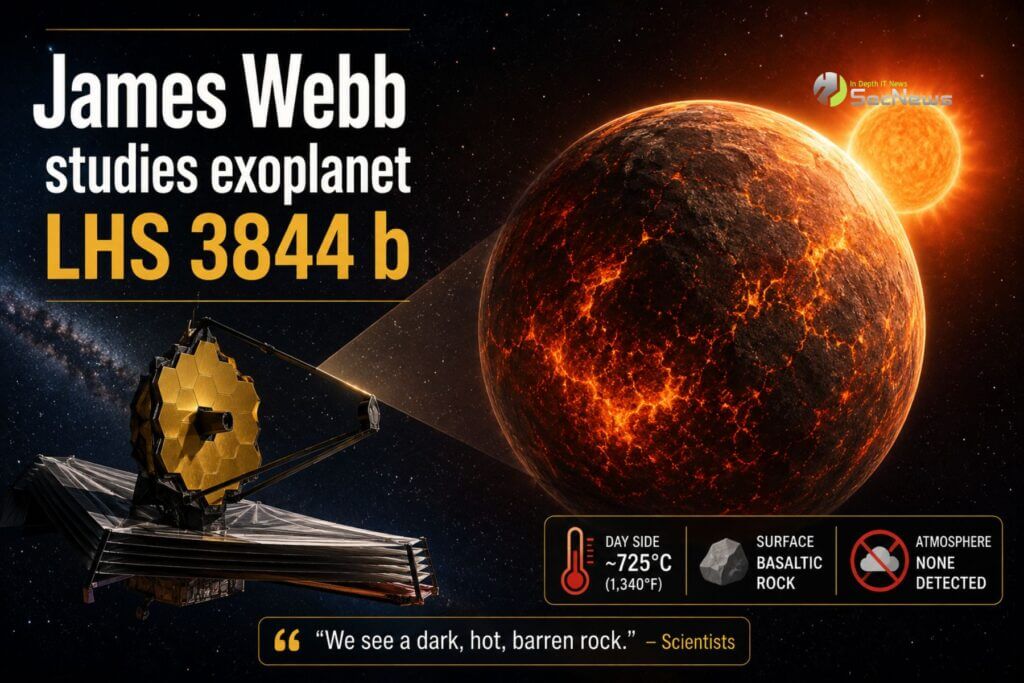
The James Webb Space Telescope data reveal a dark, arid and inhospitable planetthat appears to be completely devoid of an atmosphere. According to Laura Kreidberg from the Max Planck Institute for Astronomy, the telescope recorded thermal radiation coming directly from the planet's surface, allowing for such detailed geological interpretation for the first time.
See also: Scientists have identified 10,000 candidate exoplanets
The lack of an atmosphere makes LHS 3844 b extremely exposed to the extreme conditions of space. The bright side of the planet reaches 725 degrees Celsius, hot enough to turn the surface into a vast, scorching landscape. At the same time, because the planet is tidally locked, its far side remains permanently dark, creating an extreme thermal contrast.
This phenomenon is very reminiscent of Mercury, the closest planet to the Sun, which also experiences strong temperature fluctuations due to its almost non-existent atmosphere.
The technology behind the discovery
The observations were made in 2023 and 2024 with the help of the MIRI (Mid-Infrared Instrument), one of the most advanced infrared detection systems ever sent into space.
The scientists observed three secondary eclipses, times when the planet passed behind its star. By measuring the difference in total emitted radiation before and after the occultation, they were able to isolate the thermal footprint of the surface.
This is a technique that until recently was considered almost impossible for rocky exoplanets. Its success demonstrates the enormous sensitivity of James Webb and paves the way for much more ambitious exoplanet exploration missions.
Basalt surface and geological mysteries
By comparing the spectral data with known geological materials from Earth, the Moon and Mars, the researchers ruled out the possibility that the planet has a crust similar to Earth's.
See also: Curiosity and Perseverance reveal different sides of Mars
Instead of a surface rich in silica and granite, the evidence shows a predominance of basalt, a dark volcanic rock rich in iron and magnesium. The presence of basalt suggests either intense volcanic activity in the recent past or a surface shaped by long-term exposure to cosmic radiation.
The first theory is that fresh lava flows may be resurfacing the surface. However, if that were the case, the telescope should have detected gases like carbon dioxide or sulfur dioxide — which it didn't.
The second version speaks of space weathering, a slow process in which micrometeorites and radiation alter the chemical composition of rocks, gradually darkening them.

The next step in exoplanet exploration
The study, published in Nature Astronomy, marks a new era in exoplanet science. Subsequent observations by the James Webb Space Telescope are expected to clarify whether the surface of LHS 3844 b is solid rock or a layer of fine-grained material.
See also: SpaceX: Rocket section will "hit" the Moon
But beyond this particular planet, the significance of the discovery is much broader. The same technique could be applied to dozens of rocky exoplanets in the future, allowing scientists to map worlds that have remained invisible until now.
For astronomy, this translates into a crucial step toward understanding the geological evolution of distant planets — and perhaps, someday, discovering a world with truly Earth-like conditions.
