

Elon Musk is back in the spotlight with a new, highly ambitious plan, this time in the crucial field of semiconductor production. The Tesla and SpaceX announced his intention to create a new factory called Terafab in Austin, Texas, which will be operated jointly by the two companies. The facility aims to fill one of the biggest “gaps” in the modern technology industry: the adequacy of advanced chips for applications in artificial intelligence, robotics and space infrastructure.
What is Terafab and what is its goal
Terafab, according to what has been announced, is intended to be a state-of-the-art large-scale chip manufacturing facility. Elon Musk argues that this project is necessary in order to support the growing needs of his companies, as well as the wider market. Particular emphasis is placed on the use of data centers next-generation, as well as in infrastructure that could even be deployed in space, a scenario that is directly linked to SpaceX's long-term plans.
See also: Elon Musk threatens to halt Tesla Giga Berlin expansion
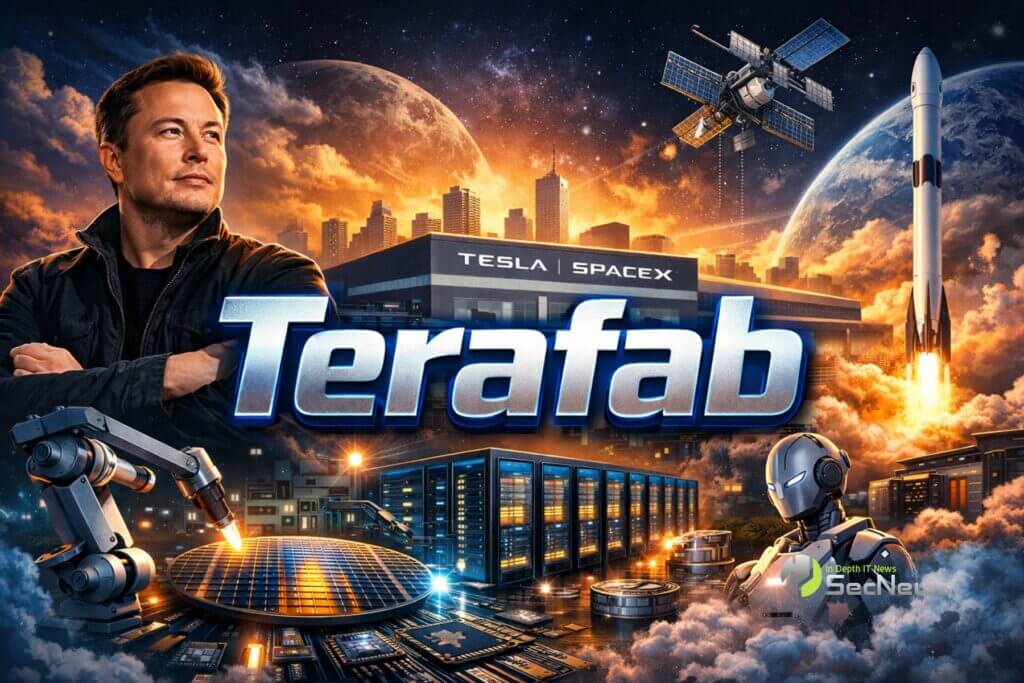
He is said to have underlined with characteristic clarity the dilemma: either Terafab will be built or the lack of chips will act as a brake on the development of the technologies he envisions. In this context, the investment is presented not simply as an option, but as a necessity.
The pressure from the explosion of artificial intelligence
The announcement comes at a time when the global semiconductor industry is being tested by rapidly increasing demand. The explosive growth of artificial intelligence has created unprecedented needs for computing power, leading to shortages and intense competition for resources. Musk, like other top industry executives, has expressed concerns that existing production capacity is not enough to meet demand in the coming years.
In this environment, Terafab is being touted as a potential large-scale solution. According to Musk, the facility could theoretically support up to 200 gigawatts of computing power per year on Earth, while at a future stage the capacity could even reach one terawatt for space applications.
See also: Elon Musk wants to send xAI employees to the Moon
The technical and economic challenges
Despite the ambitious vision, the implementation of such a project is not at all a simple matter. The construction of a semiconductor manufacturing is among the most complex and expensive undertakings in modern industry. It requires billions of dollars in investment, highly specialized equipment, and years of planning and implementation.
Moreover, the market is already dominated by strong players with decades of experience, making it even more difficult for new initiatives to enter. Analysts point out that Musk's lack of direct experience in semiconductor manufacturing could be a significant obstacle, especially combined with his history of ambitious - and often delayed - timelines.
Uncertainty around the timelines
One of the key questions that remains unanswered concerns when – and if – Terafab will be operational. Despite estimates of the scale of production and the computing power it could offer, no specific timeline has been given for the project’s completion or the start of the production process.
See also: Elon Musk merges SpaceX with xAI
The lack of clear programming strengthens the skepticism already expressed in part of the market, without however reducing interest in the venture. In any case, the development of Terafab is expected to be closely monitored, as it may significantly affect the balances on the global technology map.

The broader gamble for technology
Beyond the investment itself, Elon Musk's plan highlights a broader issue: control of the supply chain of critical technological infrastructure. In an era where chips are the "backbone" of the digital economy, the ability to produce autonomously can provide a strategic advantage.
Whether the Terafab is implemented according to the original vision or faces significant delays, the certainty is that the discussion about sufficiency and independence in semiconductor manufacturing will continue to be at the center of the global technology agenda.
