

How a team of three Greeks is saving the world from broken links with the LinkSentry tool?
Every era has its heroes. Today’s Greek pioneers are writing their own epics. In scientific laboratories or art studios, in the basements of startups or in the skyscrapers of Fortune 500 companies, Greeks around the world are redefining what it means to excel, to envision, and to lead. “Modern Greek Epics” is a new series that will shine a light on Greek innovators who solve big problems, visionaries who shape our collective future, and every extraordinary Greek who has yet to receive the attention they deserve.
How a group of Greeks is saving the world from broken links
If you’re reading this article, it’s 100% certain that you got here by clicking on a link. You may have found this article yourself, or someone shared it with you. Maybe it was a link in your social media feed. It’s 2025, so it’s very likely that you found this link from your favorite AI chatbot.
Regardless of where you found it, it was a link that brought you here.
Why are we talking about links and what does this have to do with Greece? Read until the end to find out.
See also: Microsoft: Edge's "IE Mode" revamped after zero-day attacks
In the beginning, there were links
Web links are not a new idea.
In fact, links are as old as the internet itself. In the late 1980s, Tim Berners-Lee (the “father of the web”) was working at CERN and had a problem to solve. He had to manage different documents in different formats, located on different computer networks.
Berners-Lee's idea was to create a system for linking information.
His idea was titled "Information Management: A Proposal" and he spent several years designing the first specifications for what we now call the "web", as well as implementing the first web browser, the first web server, the first HTTP specification (how web browsers communicate with web servers) and the first HTML specification (how web browsers know what to "draw" and where).
The rest, as we say, is history.
Links and Domain names
While the first web browser appeared in the early 1990s, domain names (like substack.com or gov.gr) actually preceded it as a technology.
By the 1980s, we already had networks of computers that needed to communicate with each other. While those computers were perfectly happy communicating with each other via numerical addresses known as Internet Protocol (IP) addresses, we humans weren't so good with them.
It's very easy for us to remember google.com, but much harder to remember 142.251.40.110, which is one of the numerical IP addresses that will connect our computer to one of Google's IP addresses. Domain names were invented to remove these numbers and allow us to use more memorable names.
Generic top level domains ( such as .com and .org) were the first to be available to commercial users. Country code domains (such as .gr) were introduced a few years later, allowing countries to have sovereign control over their domain names.
In Greece, domains ending in .gr are managed by the Foundation of Research and Technology Hellas (FORTH). According to public statistics, the Greek domain registry currently holds more than 500,000 .gr domain names.
Diamonds vs. Domain names
Unlike diamonds, domain names are not forever. When you buy a domain name, you are not buying it forever.
You buy domains for a set period of time: one year or multiple years, if you're willing to pay an additional fee. After that period, you must renew domain name and pay the registrar the corresponding annual fee. As long as you continue to do this, the domain name cannot be taken away from you.
See also: RealBlindingEDR tool permanently disables AV/EDR
If a domain is not renewed, it returns to the pool of available domain names. Once this happens, whoever pays the registration fee for that domain becomes the new owner of the domain name.
Entire industries have been built around domain names. So-called drop-catchers are specialized companies that analyze hundreds of thousands of domain names that expire every day, looking for the most valuable ones to re-register. These domain names can be valuable because they are short and easy to use, have been around for a long time, or have a lot of backlinks (i.e., many websites linking to their domain name).
Expired domain names and cybersecurity
If we had 100 websites linking to an expired domain name and someone else re-registered that domain name, they can now keep those 100 established links. The linking sites have no idea that this “change of hands” has happened.
Unfortunately, many of the entities re-registering these expired domains are malicious. They exploit existing backlinks and expose users to all sorts of unwanted and malicious content, from affiliate abuse and low-quality ads, to a wider range of scams and phishing websites.
Greek users and institutions are unfortunately not exempt from the increase in cybercrime. In 2024, the cost of cybercrime increased to more than 16 billion dollars, with the Greek Cybercrime Unit receiving almost 90,000 calls from affected citizens (in the same year). Expired domain names and “bad links” on websites are a great way to expose citizens to malicious content.
Greeks take action: LinkSentry
A team of three Greeks saw this global problem of malicious links and decided to do something about it.
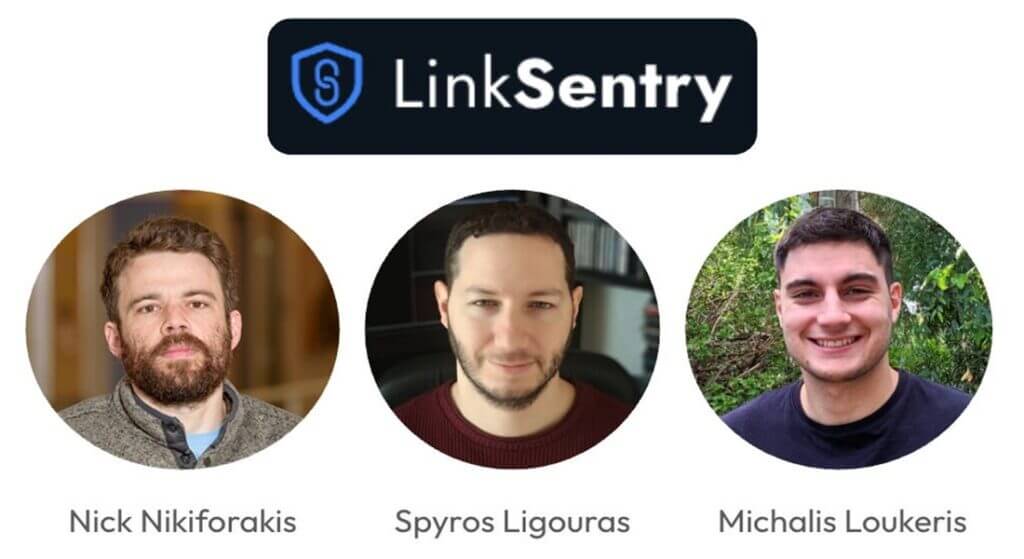
Nick Nikiforakis, Michalis Loukeris , and Spyros Ligouras launched LinkSentry, a monitoring platform that continuously monitors websites to detect malicious links before they affect users.
The tool can check all the links that were once flawless, and now find them broken, expired, and in some cases, downright malicious.
No matter how many times you check the external links on a website, it may not be enough. The next day or the next month they may be malicious. Continuous monitoring and automation are key, in a world where domains expire daily and remote websites are hacked every second.
Now, you might be thinking: “Okay, broken links are annoying, but are they really that big of a problem?” The answer is a resounding yes.
We live in an era where the web is changing faster than ever: Artificial intelligence systems are massively generating new content, algorithms are selecting what we see, and malicious actors are finding new and more sophisticated ways to trick us online. Every broken or expired link is no longer just a dead end. It’s an open door for misinformation, scams, and even large-scale digital (and social) manipulation.
See also: Hackers can inject malicious code into antivirus processes
As AI becomes the world’s biggest online reader (and writer), the web it learns from (and produces) is becoming less and less trustworthy. When legitimate sources disappear or their domains fall into the wrong hands, AI tools (and the people behind them) can unwittingly spread false, even malicious, information. A link that once led to a reliable news report could, overnight, lead to a phishing site or an AI-generated deepfake. In some cases, it could even rewrite the past.
This isn't just inconvenient. It's downright dangerous.
Beyond the security risks, something else is happening: the slow erasure of our digital history. The internet once seemed like a kind of living library. Today, old servers with critical information are shutting down, archives are disappearing, and the early web is disappearing link by link. When these connections break, we lose more than information. We lose content, memory, and trust.
That's why what this small group of Greeks is doing matters so much. They're not just fixing broken links. They're quietly protecting the continuity of the web itself. In an age where so much online content is artificial or fleeting, their mission is refreshingly human: to preserve the truth, to preserve what's real, and to ensure that when you click on a link, you can still trust where it takes you.
Isn't this the definition of a modern Greek epic?
Source: greekanalyst.substack.com
