

NASA's Jet Propulsion Laboratory (JPL) announced on Twitter that it had received a signal from Voyager 2, using the Deep Space Network , which is capable of receiving weak signals from distant spacecraft.
See also: NASA solved the mystery of Voyager 1's strange data transmissions
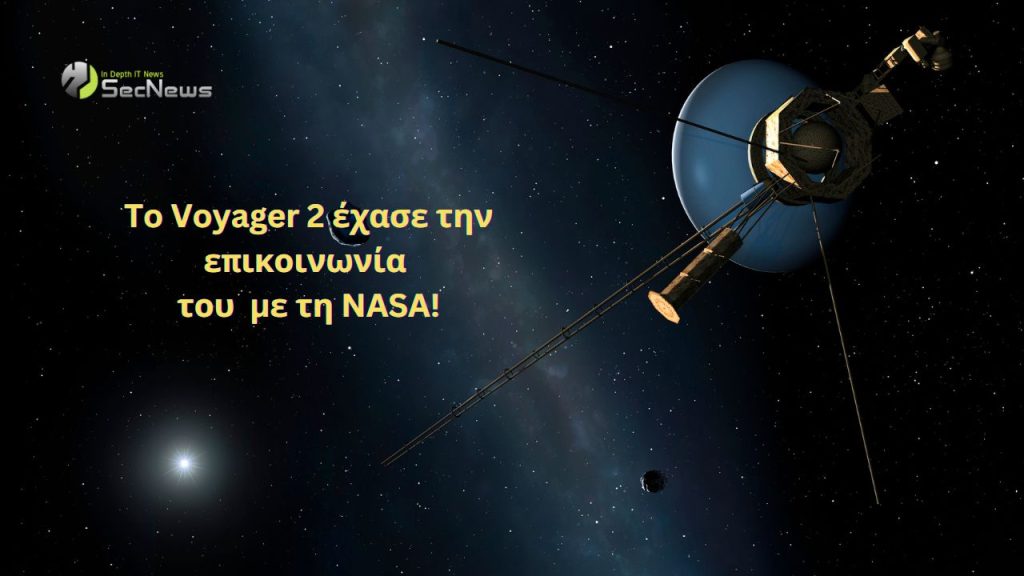
JPL announced that Voyager 2's signal, also known as its "heartbeat," confirms the spacecraft's continued transmission. "Engineers will now attempt to send Voyager 2 a command to turn toward Earth. If that doesn't work, we'll have to wait until October, when the software spacecraft's," the JPL statement added.
NASA's Voyager 2 spacecraft is now in the vacuum of space, due to a communication system failure that prevents it from receiving instructions or transmitting data back to Earth.
Communications with Voyager 2, currently about 12.3 billion miles (19.9 billion kilometers) from Earth, were disrupted as a result of programmed commands. Those commands inadvertently rotated the spacecraft's antenna two degrees away from planet , enough to cut off its connections to ground-based antennas on NASA's Deep Space Network (DSN), NASA's Jet Propulsion Laboratory (JPL) said in a statement. As a result, Voyager 2 is no longer sending data back to the DSN, and mission controllers on Earth are unable to send commands back to the interstellar spacecraft.
All is not lost, however. Voyager 2, launched in 1977, has undergone multiple corrections over the years to keep its antenna pointed toward Earth. This is to ensure uninterrupted communication with our planet. A new mission is scheduled for October 15th of this year, which will allow Voyager 2 to reestablish communication with ground control. Until then, operators expect the spacecraft to maintain its planned orbit.
See also: NASA investigates mystery with data from the Voyager 1 spacecraft

Voyager 2 launched from Launch Complex 41 at Cape Canaveral, Florida, on August 20, 1977. December 10, 2018 marked a historic moment when the spacecraft made history by becoming the second to leave the solar system and enter deep space.
Six years ago, its sister spacecraft, Voyager 1, became the first man-made object to pass beyond the confines of our solar system. Despite being some 24 billion kilometers from Earth, Voyager 1 is still in communication with our planet.
Both Voyager 1 and 2 were designed by NASA to search for and study objects at the edges of the solar system. Within this framework, Voyager 2 has achieved a series of scientific achievements, managing to cover a multitude of unique research feats. This spacecraft has conducted detailed surveys of all four giant planets of our solar system: Jupiter and Saturn ,as well as the icy Neptune and Uranus. This is a unique achievement in the field of space research.
In January 1986, Voyager 2 became the first object from Earth to fly by Uranus. During that journey, Voyager 2 discovered 10 new moons and two new rings surrounding the ice giant. This mission reports a unique discovery that is a significant addition to our understanding of our solar system and the wider world around us.
In August 1989, the spacecraft made another major discovery. During its mission to Neptune, it discovered five moons and four rings. While studying Neptune, Voyager 2 discovered a storm measuring 8,000 by 4,000 miles (13,036 by 6,600 kilometers), with winds reaching 1,300 miles (2,092 kilometers) per hour. This storm rages in a spot on Neptune known as the Great Dark Spot.
See also: Voyager 1: NASA detects a hum beyond the solar system
In April 2023, NASA announced that Voyager 2 would postpone the scheduled shutdown of its instrument by at least three years in order to continue collecting valuable data in deep space until at least 2026.
