

Astronomers have found evidence of a possible planet in the galaxy M51 (“Whirlpool”). If confirmed, it would be the first time a planet has been detected outside our Milky Way.
The discovery of the exoplanet was made using NASA's Chandra X-ray Observatory.
The planet in M51 is about 28 million light-years away. This means that a spaceship – traveling at the fastest speed possible in the universe – would take 28 million years to reach the planet.
See also: The planet Mars is too small to hold water
Exoplanets are usually discovered by monitoring small dips in light as the planets pass in front of their star – as seen from Earth.
The planet is thought to be about the size of Saturn and orbits a neutron star or black hole about 20 times the mass of the Sun.
The material near the neutron star or black hole has become superheated and glows in X-rays – which the team used to their advantage.
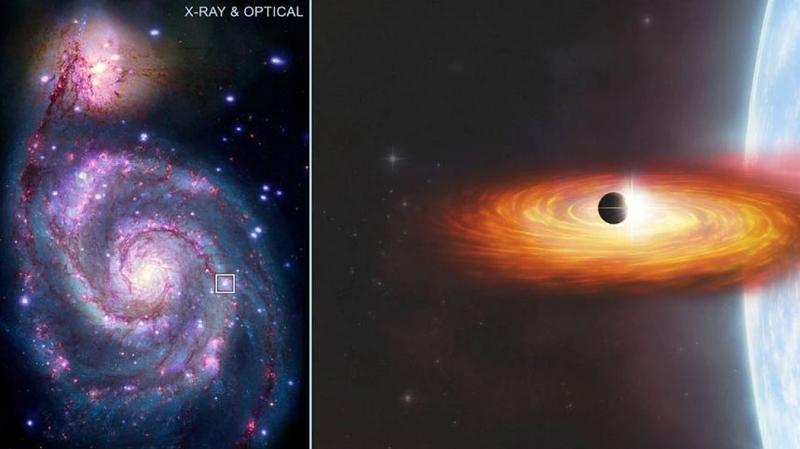
Photo: NASA
See also: Astronomers have discovered one of the youngest planets to date
Because the area producing bright X-rays is small, a planet passing in front blocks most or all of the X-rays, making the transit easier to detect because the X-rays disappear.
The X-ray transit found by the team lasted about three hours, during which time the X-ray emission decreased to zero.
Based on this and other information, the researchers estimate that the candidate exoplanet in M51-ULS-1 would be about the size of Saturn and orbit the binary system at about twice the distance of Saturn from the Sun.
The long orbit means the planet won't pass in front of the system again for about 70 years.
Rosanne Di Stefano from the Centre for Astrophysics in Cambridge led the study, published today in Nature Astronomy.
See also: Comets pounding Earth changed its oxygen levels
Could it just be dust?
There is a possibility that the decrease in brightness was caused by a cloud of gas and dust passing in front of the X-ray source.
However, the researchers consider this an unlikely explanation, as the characteristics of the event observed in M51-ULS-1 are not consistent with the passage of such a cloud. The model of a candidate planet is, however, consistent with the data.
Information source: news.com.au
