

 Hackers have managed to trick several Tesla cars into increasing their speed by 50 kilometers per hour. Specifically, researchers tried to trick a car's MobilEye EyeQ3 camera system by changing the sign that depicts the maximum permitted speed limit on the side of a road in such a way that a person driving nearby would almost never notice it.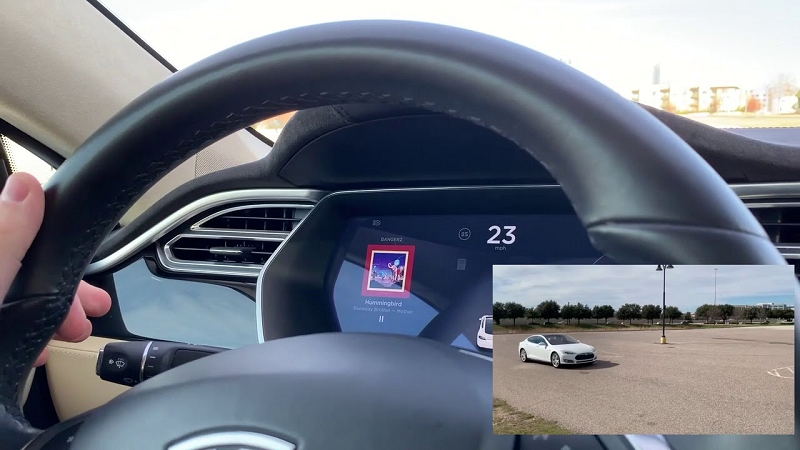
The result of this research conducted by cybersecurity company McAfee is further evidence that machine learning can destroy autonomous driving systems, thus posing a security challenge to those aiming to commercialize the technology.
Two members of McAfee's Advanced Threat Research team, Steve Povolny and Shivangee Trivedi, said that MobilEye EyeQ3 camera systems "read" speed limit signs and feed the information into autonomous driving features, such as Tesla's automatic cruise control system.
Researchers stuck a sticker so tiny it went unnoticed to a speed limit sign. The camera “read” that the sign showed a maximum speed limit of 85 instead of 35, causing Tesla’s 2016 Model X and 2016 Model S to increase their speed by 50 kilometers per hour.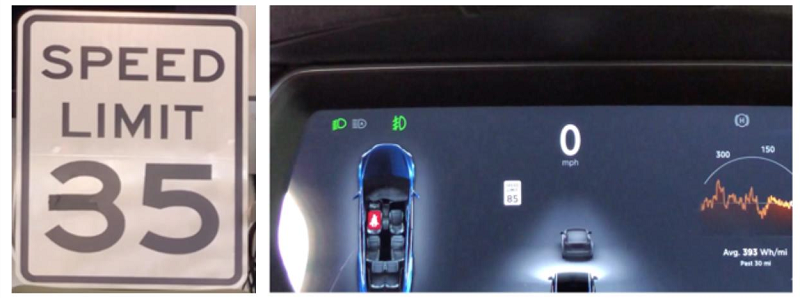
This demonstrates that machine learning systems can be hacked and fooled into critical and dangerous situations. In 2019, hackers managed to trick a Tesla car into going into the wrong lane by placing stickers on the road to manipulate the car’s machine learning algorithms. As autonomous systems proliferate, the issue of machine learning algorithms extends far beyond vehicles. A March 2019 study showed that medical machine learning systems were fooled into making poor diagnoses.
McAfee's research was shared with Tesla and its MobilEye EyeQ3. Tesla declined to comment when asked by MIT Technology Review. However, it said it acknowledged McAfee and that it has no plans to fix the issues with the current generation of hardware. A Mobileye spokesperson downplayed the research, saying the modified signal could even trick a human into reading 85 instead of 35. The company doesn't consider tricking the camera an attack, and said that despite the camera's role in Tesla's cruise control, it wasn't designed for self-driving.
A Mobileye spokesperson said that the autonomous vehicle technology will not rely solely on sensing, but will be supported by various other technologies and data, such as crowd mapping, to ensure the reliability of information received from camera sensors and offer more safety.
Since then, Tesla has decided to integrate proprietary cameras into its newer car models, while MobilEye EyeQ3 has released several new versions of its cameras, which in initial tests did not show to be susceptible to this particular attack. Finally, Povolny stated that there are still a large number of Tesla cars operating with vulnerable hardware, while also pointing out that Tesla cars with the first hardware version cannot be upgraded with newer hardware.
