

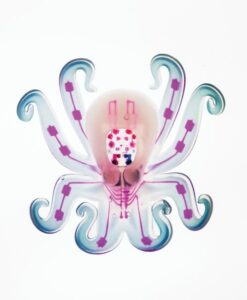
Soft robotics is a modern technology that could bring exciting changes to the way humans interact with machines. While researchers have managed to create some early prototypes, they face challenges when it comes to a completely soft robot. These challenges are the rigid parts, such as circuit boards, batteries, etc.
Using their expertise in 3D printing, mechanical engineering, and microfluidics, a team of researchers at Harvard University has unveiled the first completely soft robot. Unlike previous soft robot prototypes, it is autonomous.
This small, 3D-printed robot is nicknamed "Octobot.".
The team used the hybrid assembly approach to 3D print each functional fuel cell, actuation, and energy. The team's entire research is published in the journal Nature.
Octobot is powered by compressed air. A catalytic chemical reaction inside the robot converts hydrogen peroxide, which acts as a fuel, into a large amount of gas. This process inflates the robot's arms and helps it move.
The entire system combines three methods for building the robot – soft lithography, casting, and 3D printing. The team behind Octobot called it a simple version designed to demonstrate “an integrated design and additive manufacturing for integrating autonomous operation.”
After Octobot, the team wants to work on more complex designs and build soft robots that can crawl, swim, and respond to their environment.
