

3D NAND technology – which allows cells to be stacked vertically, improves density and increases capacity. The technology has been successfully applied to SSDs (solid-state storage) and is said to be the new trend in the characteristics of new drives. Samsung has introduced huge capacity drives so far and Intel has just introduced a new line of drives that use the technology.
Intel's new drives are aimed at consumers, enterprises, data centers, and Internet of Things (IoT) devices. 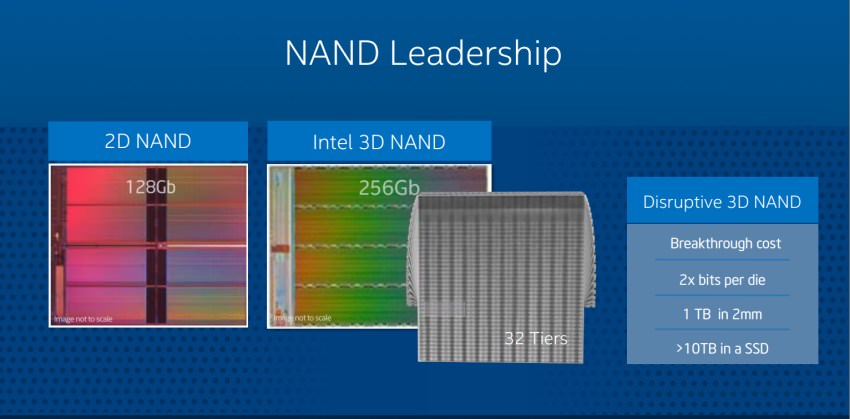
Most of them, in addition to 3D NAND technology, also use the PCIe interface for faster data transfer, although some of them make use of the slower SATA interface.
The 600P SSD and Pro Series 6000p are designed for consumer and business PCs (desktops and laptops) and both use PCIe to deliver 17 times the performance of traditional hard drives and three times the speeds of SATA solid-state drives.
They are offered in 128GB, 256GB, 512GB, and 1,024GB, with similar features: M.2 form factor and the exact same random and sequential read/write speeds.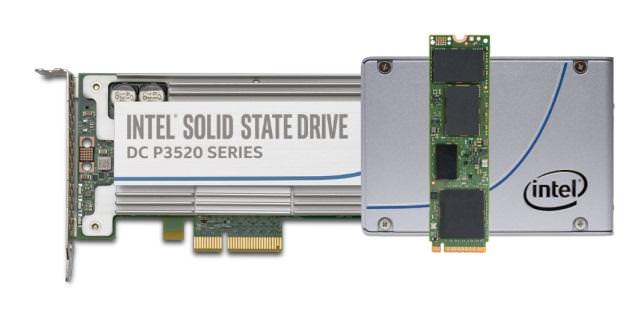
The Pro series is designed for use with Intel's vPro enterprise processors, which feature Remote Secure Erase Solution technology to allow IT professionals to erase drives from a remote location. The 600P SSDs are already showing up at online retailers, with the 128GB model costing $70.
The drives for data centers are the P3520 SSD DC and SSD DC S3520 Series. They are suitable for cloud computing services, with sequential read speeds of 1,700MB/s. The P3520 series drives will be available in capacities from 450GB to 2TB. On the other hand, the DC S3520 series uses the SATA interface instead of PCIe, and the company says it is ideal for migrating from enterprise SATA hard drives. The S3520 drives will be available in capacities from 150GB to 1.6TB, and the upper limit of sequential read speeds will be 450MB/s.
Intel also announced two SSDs (3D NAND) that can be used by IoT devices. The 6000p Series E SSDs come in capacities from 128GB to 256GB for IoT devices. The 6000p E drives feature 256-bit AES self-encryption capabilities, which is useful for use in ATMs.
