

Yesterday's announcement by the Harvard Astronomy Center about the discovery of gravitational waves and confirmation of the theory of cosmic inflation was one of the most important scientific discoveries of recent decades and came after a long and collective effort. But what was it that made it so significant? To understand its significance, it will be necessary to explain some concepts that are not in everyday vocabulary.
The Big Bang
Our knowledge of cosmology has developed rapidly over the last century. It is indicative that at the beginning of the 20thcentury we did not know that there were other galaxies besides our own. In the first quarter of the previous century it became known that not only are there many other galaxies but that they are also moving away from each other, a phenomenon called the expansion of the Universe and which overturned the image of a stable, eternal and unchanging Universe.
Doing the regression backwards, one would fundamentally assume that the Universe in the past was increasingly denser. According to astronomical observations as well as theoretical predictions, we believe that about 13.8 billion years ago the Universe was condensed into a point of infinite density, from which emerged what we call the Big Bang. Physical theories collapse at the moment of the Universe's birth, but scientists focus on the immediately subsequent moments which were decisive for the shape the Universe has today.
The cosmic inflation
The Big Bang model provides several answers about the Universe, but it leaves a series of unanswered questions: why is the Universe so homogeneous and isotropic (it looks the same in any direction we look, at any point we are), why is the Universe so amazingly tuned to be flat (out of all possible values, its density seems to balance with incredible precision at a specific value that implies a Universe described by Euclidean geometry), etc. These questions are elegantly resolved by the idea of cosmic inflation. According to it, shortly after the Big Bang (we do not know exactly when, but approximately 10-35 seconds later), the Universe expanded exponentially, for a short period of time, due to the presence of a field. The exact shape of the inflation field is not known, as there are many different models that we can distinguish according to their predictions, and for this reason scientific discoveries like yesterday's are very useful.
General Relativity and gravitational waves
The "language" with which modern Cosmology is described is the theory of General Relativity, devised by Albert Einstein in the first quarter of the 20thcentury . It is a theory of gravity, and since gravity, although the weakest of the forces, is the most dominant at large distances (matter is basically electrically neutral, while nuclear forces have a short range), it is through it that the evolution of the Universe is described.
Gravitational waves are a prediction of the theory, which however has not been confirmed to date. According to the General Theory of Relativity, gravity is linked to the deformation of the geometry of spacetime, which is caused by the presence of mass or energy – essentially the same thing. This deformation propagates in the form of waves that are very difficult to detect since they originate from a weak force.
Background radiation and polarization
The main evidence for the Big Bang theory is the so-called background radiation, the light that continues to be emitted even today, as an echo of the birth of the Universe. As it is light (of low frequency, since the intervening 13.8 billion years have "frozen"), it reveals the property of polarization. The polarization of electromagnetic radiation can be of many kinds, called modes.
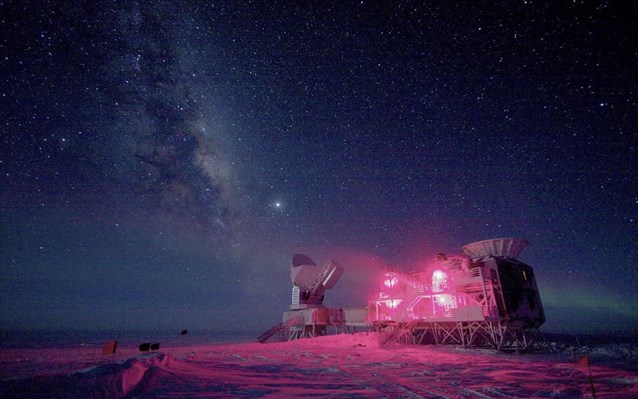
What the scientists of the BICEP experiment (Background Imaging of Cosmic Extragalactic Polarization) was a specific mode of polarization in the background radiation, called the B mode. This mode is a “signature” of the effect of gravitational waves in the early Universe, which occurred because gravitational waves compress space and time as they propagate, and this compression creates a pattern for the propagating radiation. This is where the concept of inflation is introduced, since the discovery is a prediction of this particular theory. This point is sensitive, in fact, because it opens a window of compatibility between General Relativity (a classical theory) and quantum mechanics, which is one of the biggest problems in modern physics.
The discovery made yesterday is therefore significant for a multitude of reasons and is poised to open the path for new research. First, it confirms one of the fundamental predictions of the theory of cosmic inflation and thus of the theory itself, while also providing scientists with a new method to study the Universe via gravitational waves.
