

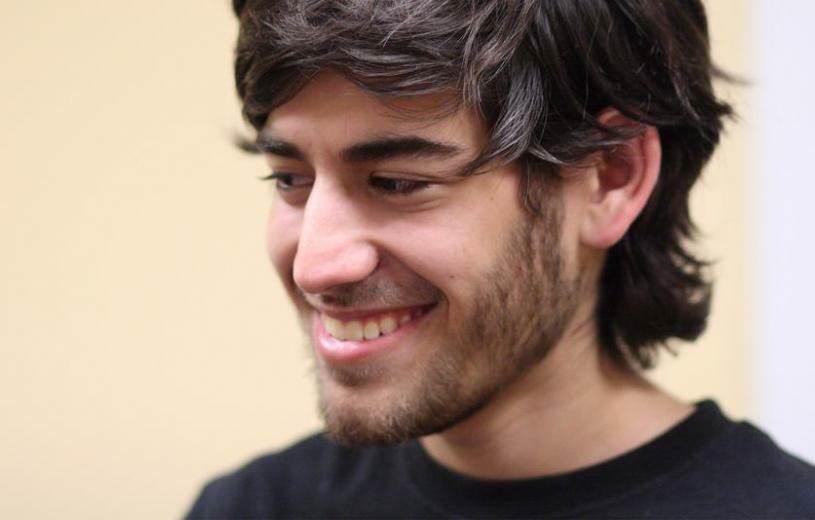
 One week ago was the anniversary of the death of Aaron Swartz, programmer, author and political activist. Aaron Swartz, for most of his life, fought for a more open and free internet. He actively participated in the fights against legislation, which aimed to restrict freedoms on the internet and concentrate knowledge in the hands of a few.
[quote]”Aaron dead. World wanderers, we have lost a wise elder. Hackers for right, we are one down. Parents all, we have lost a child. Let us weep”.[/quote]
Sir Tim Berners-Lee, inventor of the Internet (World Wide Web)
Aaron Swartz's contribution to the RSS feed standard, to web.py, tor2web, the Open Library, and the transfer of the HTTPS Everywhere plugin to Chrome was significant. He also had active involvement in the Creative Commons organization and on the Reddit site through his company Infogami.
On January 11, 2013, he was found hanging in his Brooklyn apartment. The pressure he faced from American authorities and the penalties he encountered (35 years imprisonment, one million dollars in fines) for his alleged crimes was something the always free Aaron could not endure.
However, what was the «crime» for which he was harshly persecuted by the American government and faced such great pressure that he decided to end his life. Aaron was accused of online fraud and, to be clearer, he was accused because he downloaded millions of scientific articles and journals from JSTOR, which he made public, and for which until then students paid a subscription to obtain them.
For those who do not know, JSTOR is an electronic repository of scientific articles, journals and books, which are products of research funded by taxpayers, academic institutions or various sponsors. These articles are peer‑reviewed by other academics and to be published there, the authors are required to grant the copyright. All these articles are available for a fee both to academic institutions and to private individuals. While the authors who grant their articles as well as those who review them are not compensated for their work.
This platform is a clear manifestation of the neoliberal education model. An education in which, for access to public research, students, professors, and even the researcher‑creators themselves, must pay a subscription.
In 2008, Aaron wrote and released the Open Access Guerilla Manifesto. Here is the translation of the text:
“Information is power. But like every form of power there are those who want to keep it for themselves. The world's global scientific and cultural heritage, published over the centuries in books and magazines, is increasingly being digitized and ending up in the hands of a handful of private companies. Want to read papers that have famous scientific achievements? You have to pay huge amounts to publishers like Reed Elsevier.
Opposite to this are those who resist. The Open Access movement fights hard to ensure that scientists will not surrender copyrights, but instead will publish their work on the Internet, so that everyone has the ability to read it. But even if this happens, it will only apply to publications that will be made in the future. Anything that has been published with copyright until now will already have been lost.
This is a high price. To force academics to pay money so they can read their colleagues' work? To scan entire libraries, but only let the kids at Google read them? To provide scientific articles to the best universities of the First World, but not to the kids of the Global South? It is outrageous and unacceptable.
«I agree», many may say, «but what can I do? Companies keep the rights, charge huge amounts by charging access, and it is absolutely legal — we can't do anything to stop them». Yet, there is something we can do, something that is already happening: to oppose it.
You, with access to these sources, i.e., students, librarians and scientists, have been given a privilege. You take part in this symposium of knowledge, while the rest of the world is locked out. But it is not necessary — in reality, ethically, you cannot — to keep this privilege for yourself. You have the duty to share it with the world. And you must: share your passwords with your colleagues and «download» for your friends.
In the meantime, you who are locked out, do not stand idle. Peek through holes and jump over fences, free the information that is locked by the publishers and share it with your friends.
But all this act remains in the dark, hidden in the underworld. It's called theft or piracy, as if sharing knowledge is morally the same as looting a ship and killing its crew. But sharing is not immoral — it is morally imperative. Only those who are blinded by greed would refuse to give a copy to their friend.
The big multinationals, of course, are blinded by greed. The laws under which they operate demand it — shareholders would rise up for something less. And the politicians they have bought off support them, passing laws that give them exclusive power to decide who will have a copy.
There is no justice in following unjust laws. The time has come to come into the light, in the great tradition of social disobedience, to declare our opposition to the private theft of public culture.
We must obtain the information, wherever it is stored, make copies, and distribute them to the world. We must take what is not copyrighted and put it in the archive. We need to purchase hidden databases and make them public on the Web. We must download scientific articles and upload them to file-sharing networks. We must fight for guerrilla open access.
With enough of us, all over the world, we will not only be able to send a strong message against the privatization of knowledge — we will make it a thing of the past. Will you join us?”
Aaron Swartz, 2008
by Dinos Stamos, Nikos Kokkalis
source: Barikat.gr
Republished from: koutipandoras.gr
