

RoomAlive is a follow-up to IllumiRoom from Microsoft Research. Both demonstrate what the home (or room of the future) could be like with the help of Kinect. The new system goes beyond projection mapping around the TV, adding input/output pixels on top of anything in a room. RoomAlive uses multiple depth cameras (Kinect) and spatial mapping projectors to transform the room into an interactive screen from which there is no escape .
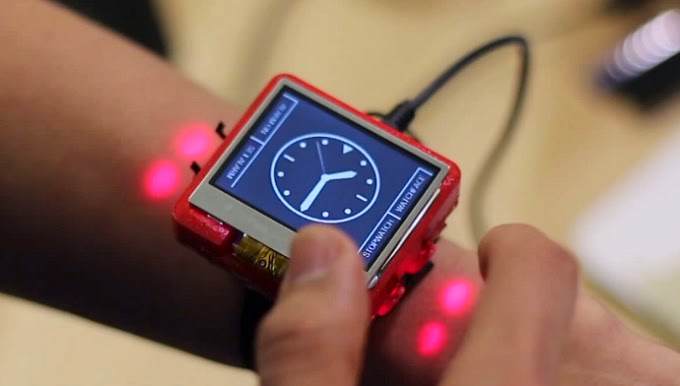
A team from Carnegie Mellon University has expanded the interaction zone of a smartwatch without increasing its size. The project, called Skin Buttons, relies on tiny projectors that project interactive buttons onto the skin around the smartwatch's screen. The parts to make the projectors cost less than $2 and can increase the device's battery life by taking over some of the screen's functions.
FlexSense , can detect its exact shape at any given moment. This means it allows for the creation of various interactive applications, such as when used as a sheet of paper (e.g. as you turn the corner of a page, various information is revealed from underneath) and so on.
Tracs ( Transparency Control for See-Through Displays) does what its name suggests, allowing the user to control transparency on the see-through displays of the future.
Teegi does show its owner's brain activity in a natural and simulated way (no orientation adjustments are required when using the screen).
HaptoMime ,is a particularly impressive device that uses ultrasound to create haptic feedback in the air, giving the user the feeling of touching a floating image (essentially the image comes from an LCD that is hidden using a system of mirrors). The device could have applications in hospitals, ATMs, etc.
