

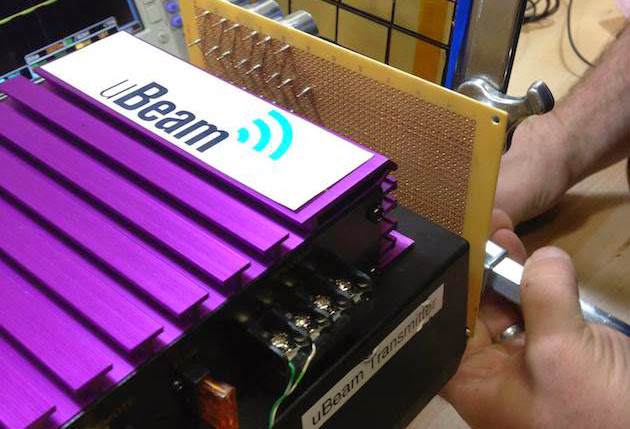
 Taking a quick look back to the past, and more specifically to the year 2011, we will remember that it was then that the famous uBeam wireless charging standard first appeared and its description was referred to as an unusual technology - for that time. Today, Meredith Perry's company, which is responsible for inventing uBeam, is taking another step forward, towards the path of evolution and announces that his team has created a fully functional standard, now capable of being applied in this form to future devices with widespread commercial availability. What makes uBeam so unusual compared to other similar proposals that various manufacturers had?
The other wireless charging standards we've seen require you to place your gadget on a charging pad, meaning the two devices must be in contact, and charging is done by inductive coupling. uBeam's technology allows you to charge your smartphone and any other device from a distance of more than one meter, even if you move the device within the same room, it will receive energy. How exactly does it work? Very simply, there is a very thin charging station, a device that receives electrical power, which it forms into a signal suitable for combining with an ultrasonic carrier signal and transmitting to the device that is near it, not next to it, but within the same room.
As one might rightly wonder, this does not happen by magic, but it is necessary to place on the smartphone or any other device that everyone wants, a receiver that can read these audio messages, performs the intended demodulation, delivering the electrical power to charge their battery. It will have limitations, such as the fact that it is not possible for these sounds to pass through walls, like the signal of Wi-Fi networks, and anyone with such increased requirements will have to buy various transmitters and have them appropriately adjusted in each room of their house. Perry is very positive and believes that at some point he will be able to transmit ultrasound through obstacles. Deep down, he is convinced that they will change the way manufacturers think about designing devices.
Source: phonegr.blogspot.gr
