

Big Brother is watching you…
In the final implementation stage, according to a well-informed source of «Καθημερινή της Κυριακής», there is a plan by the Greek Police (EL.AS.) for the purchase of unmanned aircraft (UAV – Unmmaned Aerial Vehicle). This was confirmed by speaking a few twenty-four hours ago… to the «K» top police officer, clarifying, however, that no definitive decisions have been made regarding the number and exact type of aircraft that will be selected.
According, however, to information, the Ministry of Public Order is already in advanced discussions with Israeli interest companies that specialize in the construction of unmanned aircraft. The intention of the EL.AS. staff is to use these aircraft for border control, as well as counter‑terrorism operations within the urban fabric.
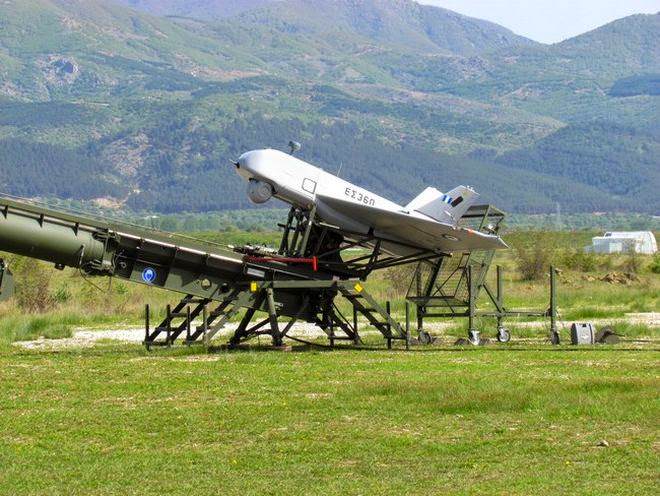
The UAVs or “Drones», moreover, can also fly silently, thus without being perceived over police‑interest areas, transporting (whether it is, for example, the Greco‑Turkish border or… for Exarchia) image, sound and other data to the operations centre of the Hellenic Police. It is characteristic that the idea to purchase unmanned aircraft originated during the period of the large gatherings of the “Discontented» in Constitution Square.
Meetings
According to a highly informed source of «K», in the autumn of 2011, under the intense pressure of large mobilizations and extensive riots in the capital’s centre, Greek officers met with representatives of an Israeli company to purchase a specific type of unmanned aircraft. The procedures were accelerated during the tenure of Minister Nikos Dendias, who, it should be noted, last summer had reached an agreement with the Ministry of National Defence to provide the Hellenic Air Force with an unmanned aircraft that was used in the operation to capture Albanian escapees from the Trikala prison.
It is reminded that on the morning of June 27, 2013 the French-made unmanned vehicle of the Army that «participated» in the investigations to locate the Albanian fugitives had crashed in the area of Agia Efthymia, Fokida. The leadership of the Hellenic Police had tried to deny the connection of the aircraft with the ongoing police operation. It had then leaked to the press that the UAVs owned by the Army are launched from a special vehicle, land with a parachute, have a flight range of 15 – 30 kilometers and the capability to integrate devices for area surveillance, mobile trace detection, wiretapping conversations, etc.
In February 2012 the Israeli company Israel Aerospace Industries (I.A.I.) presented to Greek officers at the air base in Aktio its unmanned aircraft, «Heron». The meeting was held at the initiative of the European agency Frontex and concerned the use of this type of UAV in operations for border control and tackling illegal immigration. A senior officer of the Hellenic Air Force said, indeed, to «K» that an effort is being made to purchase unmanned aircraft with EU funds that have been allocated for the period 2014 – 2020.
Tetra
Meanwhile, the Hellenic Armed Forces (EL.AS.) is preparing its return –from August 1st– to the old internal communication system, which provides for the reinstatement of simple analog radios instead of the coded TETRA system that was purchased (as a subsystem of C4I) for the duration of the Olympic Games. According to information, the discussions of the EL.AS. staff with representatives of the American company regarding the maintenance of the existing system have reached a dead end, as the annual maintenance cost amounts to €4.5 million, an amount considered prohibitive.
The last 24 hours, in fact, it seems that upgrading is being touted as a solution, instead of an amount ranging around 1.2 million euros, of the old analog system with the addition of a «mechanism» encryption of communications. It should be noted, however, that the Anti‑Terrorist unit already has its own encrypted analog internal communications system. The Tetra internal communications system, which operates only within the limits of Attica, cost the public sector about 90 million euros and its installation was completed in July 2004 by the German company Siemens which participated in the SAIC consortium.
Finally, it is worth noting that the Hellenic Police is considering the possibility of repairing the cameras that were installed in 2004 in the center of Athens and are now out of service. Moreover, as the camera base (the so‑called KAF... ) has over the years been set on fire by anti‑authoritarians, the conversion of the cameras from wired to wireless using SIM cards is being examined. The cost for reactivating each camera has been budgeted at €1,200.
Source: planet-greece.blogspot.com
