

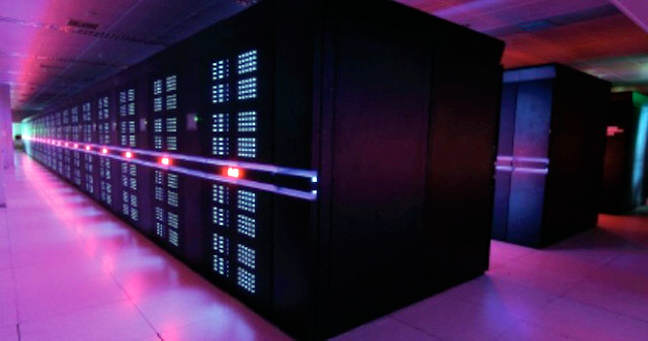
 The latest Top500 list, recently published, ranks China's digital giant, the awesome and formidable Tihane-2, in first place in the global ranking of the fastest computing systems in the world.
The creation of the National University of Defense Technology of China reaches data processing speeds of 33.86 Petaflop/second, that is, four times million calculations per second, leaving all other supercomputers behind by a long way!
Its unimaginable processing power left the other giant, the American Titan, second and sweating, since the computing power of the Cray XK7 system, installed at the government's Oak Ridge National Laboratory, ranges from 17.59 Pflop/s.
And third, the other famous American supercomputer, Sequoia, the IBM BlueGene/Q system located at the also government laboratory Lawrence Livermore National Laboratory, with its speed reaching 17.17 Pflop/s.
Despite the fact that the Chinese enjoy the first and privileged position of the fastest system in the world, the Americans remain the largest market for such machines, since 265 of the top 500 systems on the planet are located on its territory.
China recently overtook Japan from second place in consumer use of supercomputers, increasing the pace of acquisition of these colossal systems.
The only new addition to the world's top 10 supercomputers is Piz Daint, a Cray XC30 system recently installed at the Swiss National Supercomputing Centre (CSCS) in Lugano, Switzerland, which with 6.27 Pflop/s is currently the most powerful system in Europe.
Intel remains the global leader in processor supply, powering 82.4% of the systems in the Top500 index in supercomputers.
The Top500 list began in 1993 and is compiled each year by Hans Meuer of the University of Mannheim, Erich Strohmaier and Horst Simon of Lawrence Berkeley National Laboratory, and Jack Dongarra of the University of Tennessee.
The world of supercomputing is not all static, however, with the global market constantly changing. Earlier this year, Stanford University set a new record in supercomputing with a system that performed calculations on 1 million cores (8,800 cores was the previous record!)…



Source: defencenet.gr
