

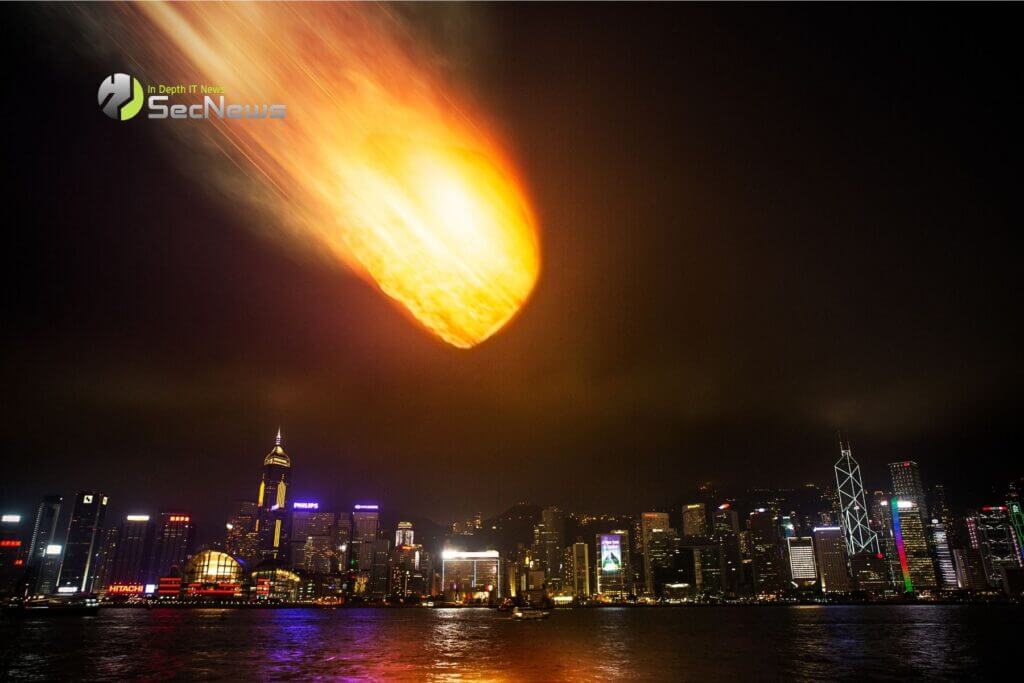
A spectacular "fireball" meteor exploded in the sky over Europe before sending flaming debris crashing into buildings in a German city — blowing a hole in the roof of a house and reaching as far as the bedroom, according to reports.
See also: Comet transforms into a giant 'cosmic rainbow'
On Sunday (March 8), at around 6:55 p.m. local time, a meteorite streaked through the atmosphere over the German state of Rhineland-Palatinate and then suddenly exploded, creating an intense flash that lasted about six seconds, according to the European Space Agency (ESA). The spectacular phenomenon likely indicates that the space rock, captured by cameras from the European AllSky7 for detecting fireballs, was “several meters” in diameter.
More than 3,000 people — including eyewitnesses from France, Switzerland, Belgium, Luxembourg and the Netherlands — reported the explosion to the International Meteor Organization. Many also said they heard the explosion in the atmosphere from the ground. ESA representatives reported that “at least one house in the German town of Koblenz-Gils appears to have been hit by small fragments of the resulting meteorite.”
Local media later confirmed that debris hit several buildings in the area. Some of the meteorite pieces have already been collected, according to Space.com. Despite the space rock fall, no injuries were reported.
See also: The largest Martian meteorite was sold for $4.3 million

It is not yet clear how many buildings were hit by the alien debris or the total extent of the damage. However, German news website Bild published several photos from the city, home to about 110,000 people, including one showing a hole the size of a soccer ball in the roof of a house. According to the local fire department, the rock that caused the damage ended up inside a bedroom, which was empty at the time.
Another photo shows nine rocks about the size of golf balls inside a brown paper bag. However, it is not known whether these are all the fragments collected, and it has not yet been confirmed that they are indeed meteorites.
So-called "fiery" meteors are created when space rocks falling toward Earth become superheated by intense friction with atmospheric air, according to the American Meteor Society. This often causes the object to break apart, creating a second, intense flash — as seen in the recent video.
See also: Ancient meteorite may reveal how water originated on Earth

Most of the resulting fragments burn up before they reach the ground or are so small that they are never detected. Sometimes, however, a few larger pieces remain intact and reach the Earth's surface, especially when the "fireball" breaks up at a lower altitude. The space rock that exploded over Germany was unknown to scientists before it entered Earth's atmosphere. However, this is "not unusual," as according to the ESA only 11 meteorites have been detected before they hit our planet.
