

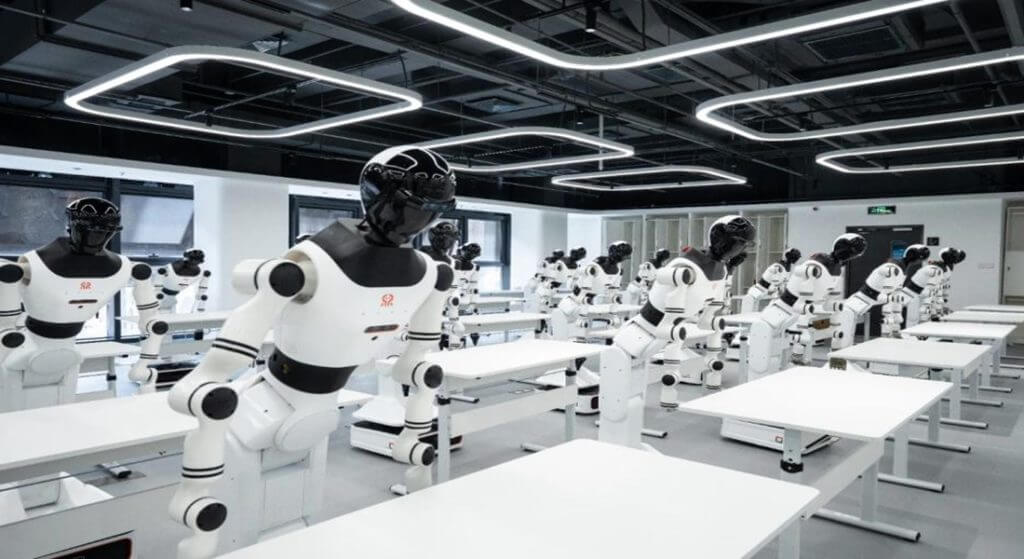
As humanoid robots gradually make their appearance in factories, services and even in domestic environments, a crucial stage of development comes to the fore: training. In the Shijingshan district of Beijing, the Phase II Beijing Humanoid Robot Data Training Center acts as a real “school” for robots, preparing them for the real world before they take on an active role in society.
This is the largest installation of its kind in China, marking the transition of robotics from an experimental stage to an industrial scale.
Realistic learning environments, like in the real world
The center spans two floors and features environments that resemble those we encounter in our work and daily lives. From production lines, sorting parts and packing packages, to cooking, tidying a bedroom and smart home functions, the robots are trained in scenarios that reflect real-world conditions.
See also: Unitree H2: Comes with improved boxing capabilities
Each training module, known as a “cell,” is modular and constantly reconfigured to adapt to different operational contexts. This flexibility allows for the collection of highly accurate datatailored to multiple applications.

Kuafu: The humanoid that learns like humans
The training program is centered on the 1.66-meter-tall humanoid robot Kuafu. The training takes place in a “small class” environment, where each robot is guided by two human instructors. As Zhu Kai, the head of the center, explains, the process is reminiscent of human learning.
"Just as a child needs repetition to learn to walk, robots need to be practiced over and over again in a variety of scenarios to acquire functional intelligence," he notes.
The big data problem and the solution of centralization
One of the key obstacles in the humanoid robot industry is the lack of high-quality, structured training data. Until recently, training was done piecemeal by individual companies, resulting in inconsistent and often low-quality data.
The Beijing center is coming to solve this problem by offering centralized and standardized data production. The data collected is cleaned, labeled, and made available to companies to train large-scale artificial intelligence models. According to estimates, the center can produce millions of data records per year.
At the same time, it is part of a nationwide data collection network, with corresponding facilities in cities such as Suzhou, Jinan, Hefei and Zhengzhou.
See also: HMND 01 Alpha Bipedal: The robot that learned to walk in 48 hours
What robots learn in "classrooms"
In the training center, robots initially choose a basic “specialization” from four main categories: industrial production, smart home, elderly care and 5G-based applications. In total, 16 sub-industries.
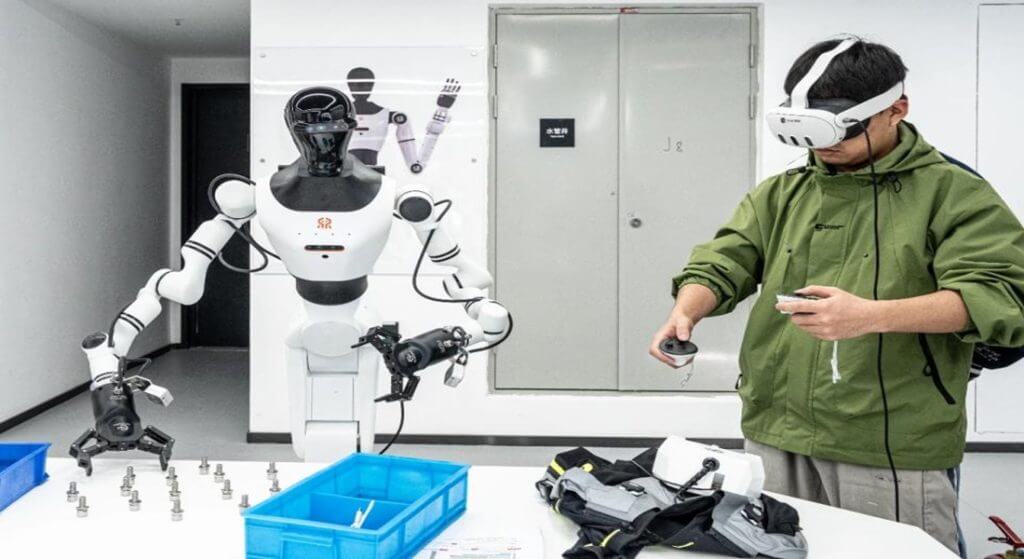
In one typical scenario, trainers Shi Xuanyu and Han Weiqi teach the robot packaging procedures. Using VR headsets and handheld controllers, the robot is guided remotely, with every move recorded precisely. A simple action, such as placing a pan on a stove, required 1,250 repetitions to perfect .
From education to the job market
To date, the center's robots have acquired over 20 functional skills, with a success rate exceeding 95%. Many of them have already graduated and are working in real-world conditions: in factories of China FAW Group, in logistics of SF Express, in energy inspections of China Southern Power Grid, or in high-tech events such as the Zhongguancun Forum.
See also: China: The bubble in the humanoid robot market is about to burst
Their success is attributed to realistic, scenario-based training that faithfully reflects the real needs of the market.
The future of humanoid robots
As industry enters a phase of rapid growth, more and more employers are looking to automation solutions with humanoid robots. Beijing is clearly investing in this future, with the training center serving as a foundation for the widespread adoption of robots in factories, services and homes.
The question now is not whether humanoid robots will become part of everyday life, but how soon — and how ready they will be when that happens.
