

Cyberattacks in the UK are rapidly increasing in frequency and severity, putting British organisations and citizens at risk, the National Cyber Security Centre (NCSC).

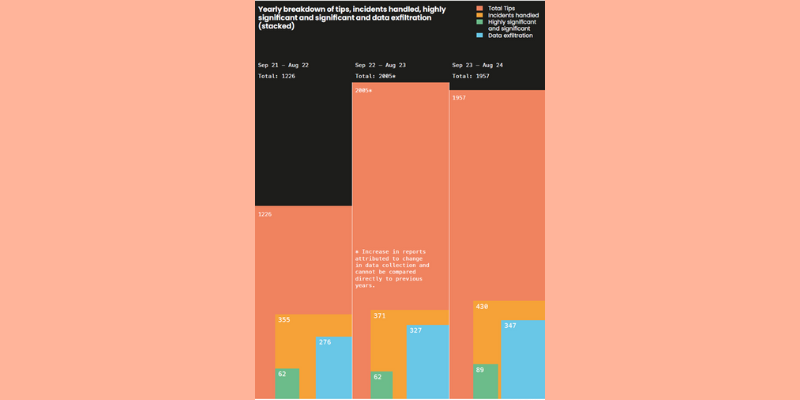
In 2024, the NCSC Incident Management Team dealt with 430 of the 1,957 cyberattacks reported. Of these, 89 incidents were classified as nationally significant, while 12 were considered critical in nature. Ransomware stood out as the most frequent threat, with 317 incidents related to preparatory actions for ransomware attacks.
Read more: Cleo Capital: New cybersecurity strategy to reduce online threats
The new CEO of the NCSC, Richard Horne, has highlighted the urgent need for stronger defences and a faster response to cyber threats. He stressed that cybersecurity should be seen as an investment that drives innovation and growth. The NCSC plans to focus on translating its strategies into practical solutions and strengthening the resilience of critical infrastructure.
At the same time, the government is promoting the “Cyber Essentials” program, which reduces the risk of cyber threats by 92%. Attacks such as the one that hit Synnovis have a serious impact on critical services, highlighting the need for stronger protection measures. The NCSC also collaborates internationally to combat ransomware, providing guidance and supporting joint initiatives to avoid ransom payments.
The Rise of Attacks by State Actors
The Annual Review describes the 2024 cyber threat landscape as “pervasive and dangerous,” with the increasing frequency and impact of cyberattacks, particularly from state-sponsored actors. Over the past year, the NCSC has noted that geopolitical conflicts have exacerbated instability in the cyber threat. For example, Russia has used destructive malware against Ukrainian targets and attempted systematic interference in NATO countries’ systems to support its war efforts.
It also noted that Moscow is increasingly encouraging non-state actors to launch attacks against critical national infrastructure (CNI) in the UK and the Western world. These actors are not subject to direct state control, making their actions unpredictable. However, the report highlights that Russia remains responsible for these ideologically driven attacks.
China is emerging as a highly sophisticated and capable cyberattacker, targeting a variety of sectors. In February 2024, the NCSC co-signed a warning about breaches of US Critical National Infrastructure (CNI) by the Volt Typhoon. In March, the British government accused Chinese state actors of attacks on democratic institutions.
Read also: GitHub CLI RCE vulnerability allows execution of malicious commands
At the same time, Iran continues its aggressive actions in cyberspace, while North Korea focuses on raising revenue to circumvent sanctions and gather intelligence through its activities.
The increasing complexity and geopolitical implications of cyber threats require collective action, and the NCSC Annual Review highlights the criticality of proactively and coordinatedly addressing them.
Source: infosecurity-magazine
🔒 Protect your privacy with Proton VPN
Swiss VPN from the creators of Proton Mail — strict no-logs policy, strong encryption, and built-in NetShield that blocks ads, trackers, & malware.
- ✔ No-logs, based in Switzerland (except 14-Eyes)
- ✔ NetShield: blocks ads, trackers & malicious domains
- ✔ Covers all devices — free version available
The link is an affiliate link — SecNews may receive a commission at no additional cost to you. It does not affect the independence of our article writing.
