

Using data from NASA's MESSENGER spacecraft, scientists believe a layer of diamonds, 15 km thick, may lie beneath Mercury's crust.
Mercury is the smallest planet in our solar system and the closest to the Sun. Mercury has several properties that set it apart from other planets. These include its very dark surface, its extremely dense core, and the early end of its volcanic era.
Traces of graphite , a type of carbon, have also been detected on its surface . This leads scientists to believe that the tiny planet had a carbon-rich magma ocean. This ocean likely created the graphite elements and the dark hue of Mercury's surface.
See also: New research: Could there be life on Mercury?

The same process may have also led to the formation of a carbon-rich mantle beneath the surface. The team behind these findings believe that this mantle is not graphene, as previously thought, but another, much more valuable type of carbon: diamonds.
“Given the new estimate of the pressure at the mantle-core boundary, and knowing that Mercury is a carbon-rich planet, we calculate that the mineral that would form on the surface between the mantle and the core is diamond and not graphite,” said Olivier Namur, associate professor at KU Leuven. “Our study uses geophysical data collected by NASA’s MESSENGER spacecraft.”
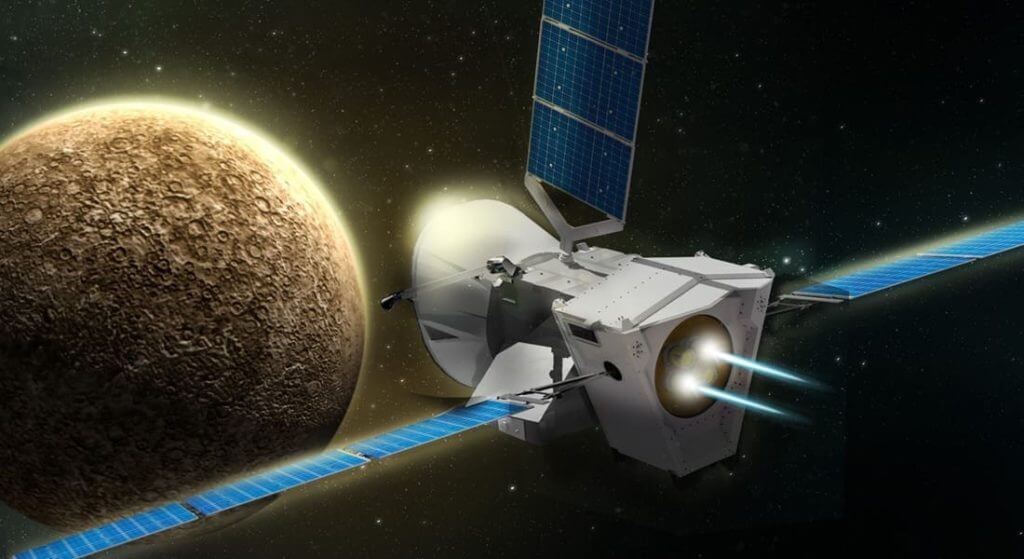
MESSENGER (Mercury Surface, Space Environment, Geochemistry, and Ranging) was launched in August 2004 and became the first spacecraft to orbit Mercury. The mission concluded in 2015, mapping the planet and gathering data on Mercury's geology and magnetic field.
Scientists used previous knowledge, data from the spacecraft, and a computer modeling to evaluate data about Mercury's interior, which gave them clues about how the diamond mantle on Mercury might have formed.
"We believe that diamond could have formed by two processes. The first is the crystallization of the magma ocean, but this process probably contributed to the formation of only a very thin layer of diamond at the core/mantle interface," Namur explained. "The second and more important process involves the metallic core Mercury's."
See also: Mysterious creature around Mercury sings!
Namur said that when Mercury formed about 4.5 billion years ago, the planet's core was liquid and gradually crystallized over time. The exact nature of the solid phases in the inner core is currently not well known, but the team believes that these phases must have been low in carbon.
“The liquid core before crystallization contained little carbon; therefore, crystallization leads to carbon enrichment in the remaining melt,” he continued. “At some point, a solubility limit is reached, meaning the liquid cannot dissolve any more carbon, and diamond is formed.”
Diamond is a fairly dense mineral, and it is estimated that during this process, it floated to the top of the core, stopping at the boundary between Mercury's core and mantle. This would have resulted in the formation of a layer of diamonds about a kilometer thick that continued to grow over time.
The new findings highlight the differences between the formation of Mercury and other rocky planets, such as Venus, Earth and Mars.
See also: Scientists reveal the end of the solar system
“Mercury formed much closer to the sun, probably from a carbon-rich dust cloud. Consequently, Mercury contains less oxygen and more carbon than other planets, which led to the formation of a diamond layer,” Namur added. “However, the Earth’s core also contains carbon, and the formation of diamonds in the Earth’s core has already been proposed by several researchers.”
The discovery of a diamond mantle on Mercury has important implications for science, as it could revise existing theories about the planet's geological and thermal evolution. The presence of diamonds suggests extremely high pressures and temperatures during the planet's formation, which could provide new insights into conditions in the early solar system.
This discovery may also affect theories about the distribution of elements and minerals on the planets of the solar system.
Finally, these findings are expected to boost interest in exploring the planet and other bodies in the solar system. The prospect of finding valuable minerals could lead to new missions and investments in space exploration.
Source: www.space.com
