

During renovations in his basement, a Turkish homeowner discovered a hole leading to an abandoned underground city that once had 20,000 residents.
See also: Mysterious tunnel may lead to Cleopatra's tomb!

To find one of his chickens that had escaped, the man knocked down a wall. During this process, he discovered a dark tunnel that led to the ancient city of Elengubu, known today as Derinkuyu.
Turkish experts explained to the BBC that Derinkuyu is an underground city in Cappadocia, which lies more than 85 meters below the ground. This city is the largest excavated underground city in the world and is connected to more than 200 smaller, separate underground cities that have been discovered in recent decades.
The underground city of Cappadocia has over 600 private residences on its modern surface. Researchers have discovered 18 levels of tunnels, which include residences, food storage, cattle stables, schools, wineries and even a chapel. The city also had a ventilation system that provided its residents with fresh air and water.
"Life underground was probably very difficult," said one expert.
«Residents used sealed clay jars for toilets, lived by torchlight, and disposed of their dead in designated areas . ».
See also: Great Pyramid of Giza: Secret corridor found
It is unclear exactly when the impressive city was built, however ancient texts dating back to 370 BC indicate that Derinkuyu already existed.
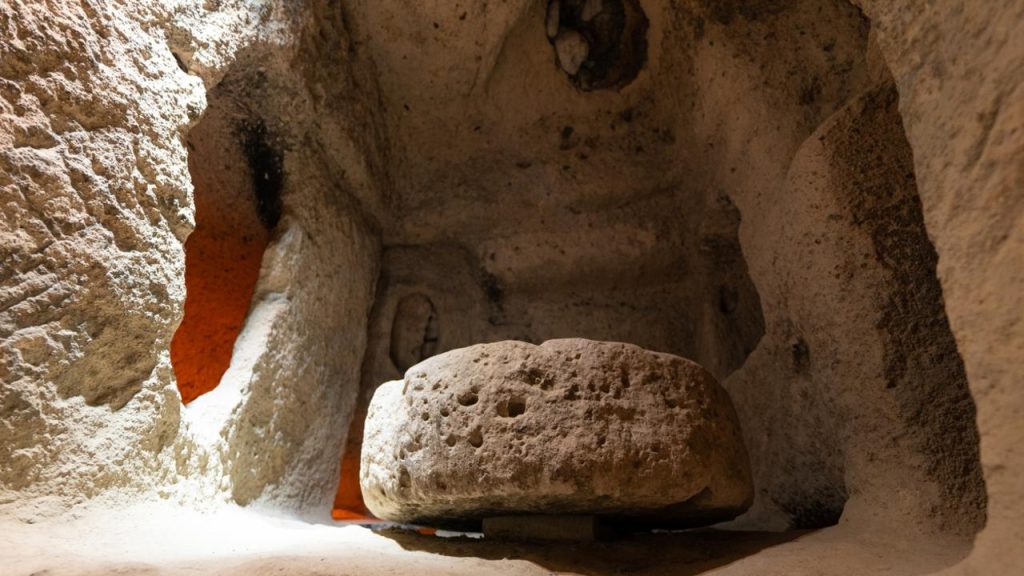
Initially, the city was used to store goods, but then it was transformed into a refuge from foreign invaders. The corridors were deliberately built narrow and low, to force invaders to crouch and enter one by one.
The doors connecting the levels were blocked with boulders that could only be moved from the inside, with only a small hole allowing the residents to see who was coming from the other side.
Although the identity of the architects is not known, researchers hypothesize that the Hittites, a Bronze Age people of Anatolia, were the first to build their caves, but were attacked by the Phrygians around 1200 BC, as Mediterranean cave dwelling expert A. Bertiniin his 2010 essay on regional cave architecture.
The BBC reports that during the 7th-century Islamic invasions of the Christian Byzantine Empire, the city had probably reached a peak population of 20,000. After 2,000 years of use, Derinkuyu was finally abandoned in 1923 by the Greeks of Cappadocia, who fled to Greece after the Greco-Turkish War.
See also: Golden Boy: The 2,300-year-old golden mummy that was hidden for a century
The ancient underground city of Derinkuyu is now open to visitors for those who want to discover its underground world. It has been protected by UNESCO since 1985 as a World Heritage Site.
