

Two years ago, the Event Horizon Telescope (EHT) gave us the first stunning image of a supermassive black hole at the center of the galaxy M87. Now, the same telescope has revealed a detailed image of a plasma jet spewing from the supermassive black hole at the center of the nearby galaxy Centaurus A.
Plasma jets are released when matter from the galaxy falls towards its black hole – and as a result energy is shot back, often at speeds close to the speed of light.
See also: He paid $28 million to participate in Jeff Bezos' space flight but he won't go
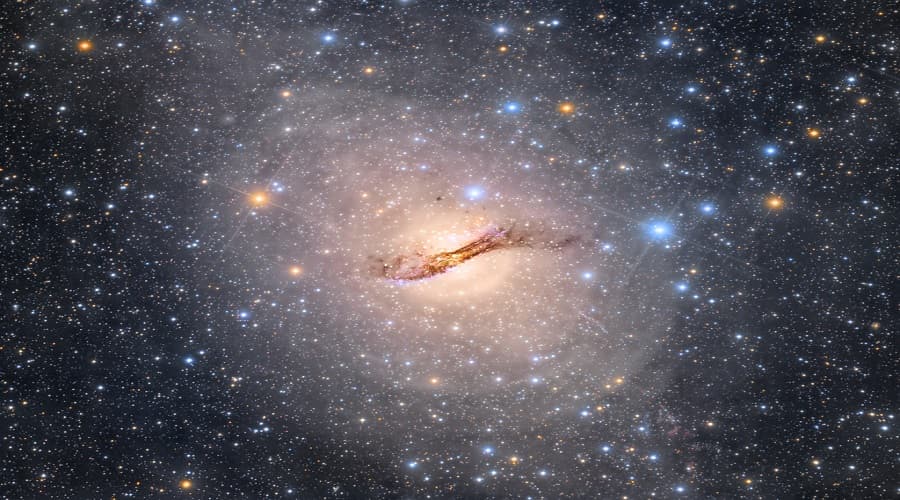
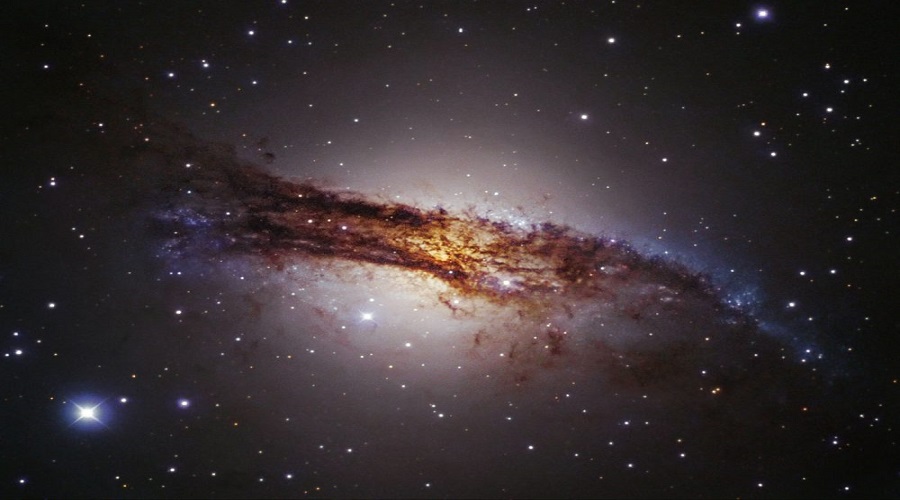
The new image from the Event Horizon Telescope is both beautiful and offers new details. At an average distance of 12 million light-years away, the galaxy Centaurus A is the closest radio-loud source to Earth. The galaxy is known for its supermassive black hole, which shoots out powerful plasma jets that we can detect here on Earth.
In the new image, a plasma jet is captured in a way that allows scientists to see details they've never seen before and understand exactly what's happening in these jets.
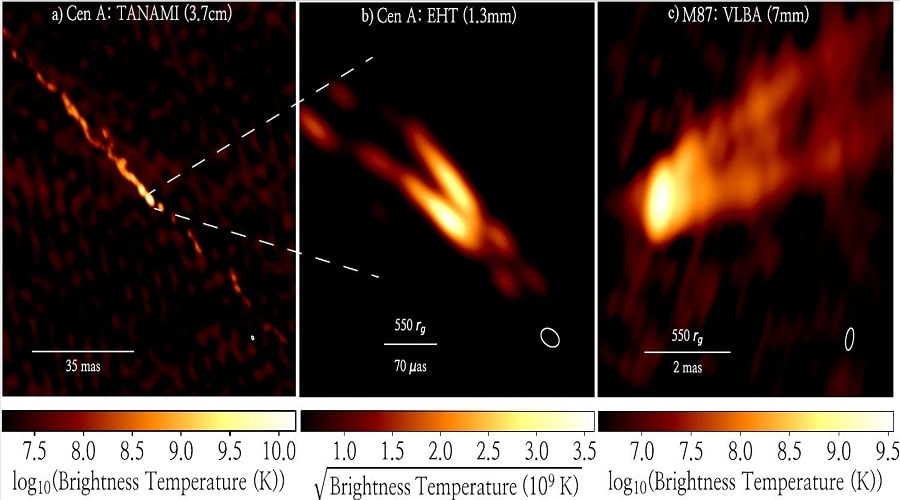
“We usually see these jets… on larger scales, and now we are actually looking at the center of the source,” explains the study’s first author, Michael Janssen, from the Max-Planck-Institut für Radioastronomie.
“Centaurus A is the closest radio galaxy to Earth and was actually discovered as one of the first extragalactic radio sources. Because of this feedback we can see the outflow [of the jet] as it moves through the galaxy and see what it does to the gas and how it can trigger star formation, which is a very broad research project“.
See also: NASA: The moon is "wobbling" and Earth will have more floods
Furthermore, the high-resolution observations of the plasma jet match what we would expect to see based on the general theory of relativity – meaning once again, the Event Horizon Telescope images show that Einstein was right.
General relativity was also confirmed by observations of M87 in 2019, but astronomers have now discovered that the same is true for less massive black holes, which absorb less matter.
The black hole at the center of the galaxy Centaurus A* has a mass equivalent to 55 million times the mass of our Sun. However, it is about 100 times less massive than the black hole in the galaxy M87*.
On the other hand, it is larger than the black hole at the center of our own Milky Way Galaxy.
The black hole of Centaurus A offered a good means to test Einstein's theory.

In the new image, the Event Horizon Telescope is unable to image the shadow of the black hole itself, which it had done with the black hole of M87*, in 201. But astronomers can see almost the source of the plasma jet.
The plasma jet looks like a hollow 3D cone with bright edges. Overall, its properties and geometry are very similar to jets in M87, as well as others that have been observed from smaller black holes.
The new image also shows where the plasma jet ends, which is very important, as Janssen explains that those points in the jets are where particle acceleration is likely occurring and are a candidate source for extremely high-energy rays.
Astronomers have detected many plasma jets from many galaxies, but they still don't understand exactly how they work.
See also: Venus: Its surface behaves like sea ice
All this detail in the new image is important, as it gives astronomers the data they need to be able to examine general relativity in the laboratory.
“We can at this point effectively create a black hole in a box to some extent,” explains researcher Sera Markoff from the University of Amsterdam, who is involved in the EHT project.
But of course there are limitations. Not everything is understood. The new image offers new insights, but researchers still have a lot to learn, such as what exactly happens at the boundary between the plasma jet and the black hole itself.
For now, there is a lot of data that astronomers can exploit thanks to this image and we hope that this will help to better understand black holes, which remain some of the most mysterious objects in the Universe.
The research was published in Nature Astronomy.
Source: ScienceAlert
