

New research shows how an invention by the great engineer and inventor Nikola Tesla can be used today, 100 years later, in ways that scientists had not realized until now.
Nikola Tesla had won a patent for a device he created in 1920, one of many groundbreaking inventions he created.

After about a century, scientists have found that the well-known invention “Tesla Valve” may be more useful than initially thought, and could have other, completely new applications.
See also: Scientists create early human embryo models from stem cells
"It is remarkable that this invention made 100 years ago is still not fully understood and may be useful in modern technologies in ways that have not yet been explored," said Leif Ristroph, a researcher and associate professor at the Courant Institute of Mathematical Sciences, New York University.
Nikola Tesla is best known for his inventions related to electricity and electrical circuits. But he also worked in the field of fluid flow, and his work was truly groundbreaking for its time.
Tesla referred to the device as a “valvular conduit,” now known as the “Tesla Valve.” It is a kind of strange fluid conduit where a series of loops are inserted into the main channel, oriented in such a way that fluids flow easily in only one direction. Flow in the opposite direction is almost blocked.
See also: Wearable device turns your body into a "biological battery"!
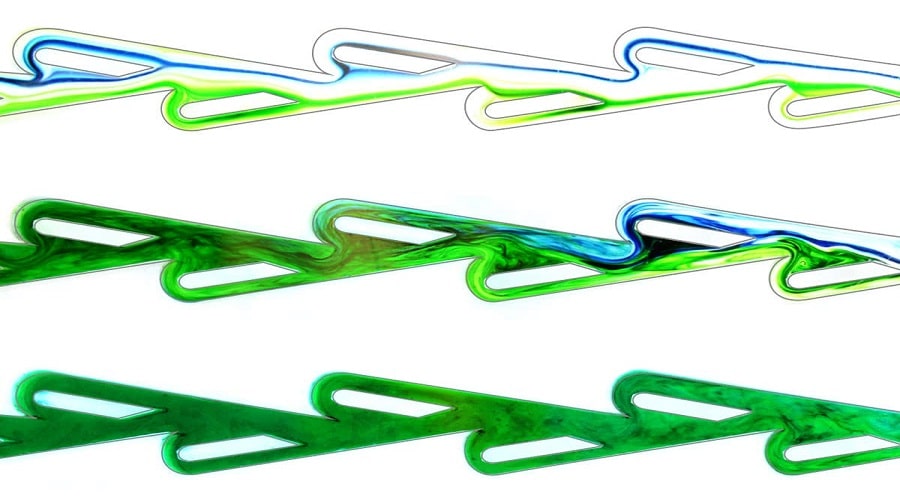
Furthermore, a key advantage of this design is that there are no elements, such as springs and other mechanisms, that could wear out.
Now, the researchers say the invention could be used for other purposes as well. They found that the device can act as a “switch,” since when the fluid is moving in the wrong direction, there is resistance and the flow is slower. Therefore, there is the ability to control the flow, which is very useful in some situations.
In testing, the researchers found that the Tesla Valve works best if the fluid doesn't come in a steady stream, but rather "pulsates," with more or less fluid coming in at certain times. However, the fluid coming out the other side is converted to a steady, smooth flow.
Scientists suggest that this behavior could be exploited in new ways, including using it to pump fuel or other liquids into engines and machinery.
See also: Scientists created "chimeric embryos" from a human and a monkey!
This function is similar to AC to DC converters.
“We think that this is what Tesla had in mind for this device, as he was thinking of similar functions with electrical currents,” said Professor Ristroph.
All of these new discoveries could allow a 100-year-old device to be used on newer equipment.
“Nikola Tesla’s device is an alternative to the conventional flow control valve, which has elements that tend to wear out over time,” explains Ristroph. “And we now know that the device is very efficient for pumping fuel or other gases and liquids.”
Source: The Independent
